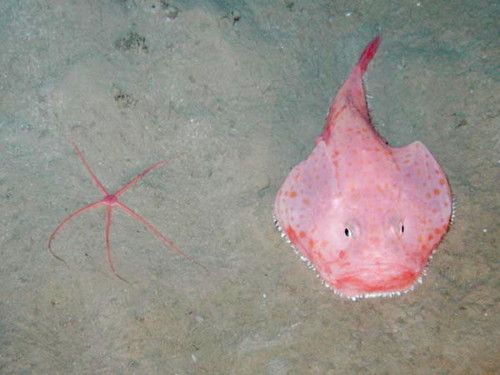
Painted Anglerfish
Chaunax pictus
Meet the Atlantic's 'walking' deep-sea resident, a rosy-hued master of disguise that fishes for its own dinner. With its pouting red mouth and specialized fins, the Painted Anglerfish is a true marvel of the benthic world.
Quick Identification
Size
Typically reaches 25-40 cm (10-16 inches) in length; weight is generally between 1-2 kg (2.2-4.4 lbs).
Colors
Distinctive rosy pink to deep reddish-orange upper body with a paler, whitish-pink belly; the interior of the mouth and the gill chambers are often a striking bright red.
Key Features
- Modified pectoral and pelvic fins used for 'walking' on the seafloor
- Retractable lure (illicium) tucked into a groove on the snout
- Large, pouting mouth with a cavernous red interior
- Loose, flabby skin covered in small, prickly scales
When You’ll See Them
Geographic range
Where Does the Painted Anglerfish Live?
The Painted Anglerfish is a resident of the Atlantic Ocean, with a wide distribution that spans both the eastern and western margins. In the Western Atlantic, it is found from the coast of Massachusetts in the United States down through the Gulf of Mexico and Caribbean to the waters off Brazil. In the Eastern Atlantic, its range extends from the Mediterranean and the coast of Morocco southward to South Africa, thriving in the deep, cold waters away from the coastal shallows.
Basemap © OpenStreetMap contributors
Behavior
The Painted Anglerfish, often called the Pink Frogmouth, is a master of patient predation. Unlike most fish that swim through the water column, this species spends its life on the seafloor, using its specially adapted fins to 'walk' or hop across the sediment. It is a sedentary ambush predator that relies on its camouflaged, lumpy body to blend into the muddy or sandy substrates of the continental slope.
Its most fascinating behavior is the use of its 'fishing pole'—a modified dorsal fin spine located on its head. When a potential meal wanders nearby, the anglerfish extends this lure to wiggle and entice prey toward its mouth. It is also known for its 'gulping' behavior, where it can inflate its body with water or air, a defense mechanism that makes it appear larger and more difficult for predators to swallow. While solitary and rarely seen by humans due to its deep-water habitat, it is a vital component of the Atlantic's benthic ecosystem.
EverydayEarth exclusive
Camera Tips
Capturing a Painted Anglerfish on camera requires specialized equipment, as they live far below the depths reachable by standard backyard or scuba setups. If you are deploying a deep-sea drop camera or using a remotely operated vehicle (ROV), target the 'transition zone' of the continental slope where the shelf begins to drop off significantly. These fish prefer soft, silty bottoms where they can sit motionless, so look for flat expanses of seabed rather than rocky reefs.
Because the deep sea is pitch black, high-powered artificial lighting is a must. Use warm-toned LEDs to bring out the natural rosy hues of the fish; otherwise, they will appear dull gray in the blue-tinted light of standard underwater strobes. Position your camera at a low angle, roughly 12-18 inches off the seafloor, to capture their unique 'walking' stance and the detail of their lure. A slight downward tilt helps reveal the texture of their skin against the sand.
Bait is extremely effective for attracting these ambush hunters. Using a mesh bag filled with chopped squid or oily fish like mackerel will draw in the small crustaceans and minor fish that the Painted Anglerfish preys upon. Set your camera to record in long intervals or use a motion-trigger optimized for low-light environments. Be patient—these fish move slowly and may sit near the bait for hours without striking, providing excellent opportunities for high-resolution stills.
Frequently Asked Questions
Record Painted Anglerfish at your habitat
Connect a camera to start building your own species record — AI identifies every visitor automatically.