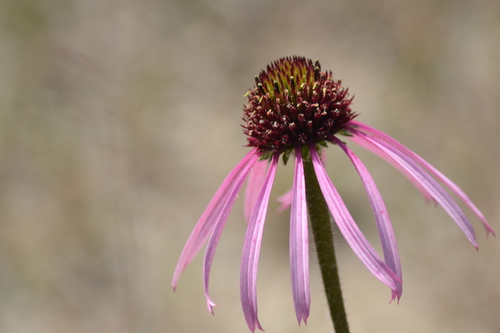
pale purple coneflower
Echinacea pallida
A tall, elegant icon of the American prairie, the pale purple coneflower is a magnet for butterflies and a favorite snack for goldfinches.
Quick Identification
Size
Grows 60-90 cm (24-36 inches) tall with a single, unbranched hairy stem.
Colors
Pale pink to lavender drooping ray florets with a central cone of dark orange-brown disk florets and white pollen.
Key Features
- Narrow, drooping pale pink petals
- Prominent spiny orange-brown central cone
- White pollen grains on disk flowers (distinct from E. purpurea)
- Stiff, hairy lance-shaped leaves near the base.
When You’ll See Them
Geographic range
Where Does the pale purple coneflower Live?
This resilient wildflower is native to the central region of North America, with its core populations found throughout the Midwestern United States. It flourishes from the Mississippi River Valley westward into the Great Plains, reaching as far north as Ontario, Canada. While it is most concentrated in states like Missouri, Illinois, and Iowa, its popularity in native landscaping has helped it establish in pocket prairies and suburban gardens far beyond its historical wild boundaries.
Basemap © OpenStreetMap contributors
Behavior
The pale purple coneflower is a hardy perennial that plays a central role in the ecosystem of the American prairie. Emerging in early spring, it spends several months developing a deep taproot that allows it to withstand significant drought and heat. Once the heat of June and July arrives, it sends up a tall, sturdy stalk topped with its iconic drooping flower head, designed to provide a stable landing platform for large pollinators.
Unlike many garden cultivars, this species is exceptionally long-lived and provides a seasonal rhythm for local wildlife. During the day, it is a hub of activity for native bees and butterflies seeking nectar. As the flowers fade in late summer, the spiny central cone dries out, turning into a natural bird feeder filled with oil-rich seeds that are a favorite of wintering songbirds.
EverydayEarth exclusive
Camera Tips
When setting up an AI-powered camera to monitor pale purple coneflowers, focus your lens on the central cone rather than the petals. This is where the 'action' happens—pollinators like monarch butterflies and bumblebees will spend the most time here. Position your camera at a slight downward angle, approximately 2-3 feet off the ground, to capture the intricate details of visitors landing on the spiny disk florets.
Because these plants are tall and have slender stems, they tend to sway significantly in the wind. To avoid hundreds of false triggers on your trail camera, use a 'zone' setting to focus movement detection on the flower head itself or reduce sensitivity during breezy days. Early morning light (6-9 AM) provides the best color saturation and is often when the first pollinators arrive while the dew is still on the petals.
Don't pack your camera away once the flowers fade! The dried seed heads are a magnet for American Goldfinches in the late summer and autumn. Keep the camera active through September to capture these colorful birds as they cling to the spent cones to extract the seeds. If your camera has a macro or close-focus mode, this is the perfect species to test it out on, as the texture of the orange-tipped disk flowers is visually stunning.
Similar Species
Species that look similar or are commonly confused with pale purple coneflower.
Frequently Asked Questions
Record pale purple coneflower at your habitat
Connect a camera to start building your own species record — AI identifies every visitor automatically.