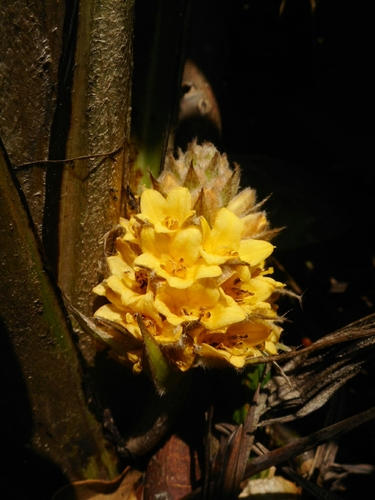
palm grass
Curculigo capitulata
A botanical master of disguise, the Palm Grass features stunning accordion-pleated leaves and golden flowers tucked away at its feet. It is the ultimate structural plant for creating a tropical wildlife sanctuary in your own backyard.
Quick Identification
Size
Height 0.6–1.5 m (2–5 ft); leaves 30–100 cm (12–40 in) long, 5–15 cm (2–6 in) wide
Colors
Lush deep green foliage; bright yellow flowers with six petals; brownish-white fuzzy base
Key Features
- Distinctive pleated (plicate) leaves resembling a seedling palm
- Dense, spherical flower clusters found hidden at the leaf bases
- Stout, arching growth habit often called 'Whale Back'
When You’ll See Them
Geographic range
Where Does the palm grass Live?
Palm Grass is native to a broad swathe of the tropical and subtropical Eastern Hemisphere, originating in the eastern Himalayas and eastern India. Its range extends through southern China and Indochina, down through Malesia and New Guinea, reaching as far as the Solomon Islands and the northern rainforests of Queensland, Australia. Due to its popularity as an ornamental, it has been introduced to gardens across the Americas and the Caribbean.
Basemap © OpenStreetMap contributors
Behavior
Palm Grass is a resilient, evergreen perennial that behaves as an understory specialist. It thrives in low-light environments where other plants might struggle, using its broad, pleated leaves to capture every available photon. While it remains stationary, it spreads slowly through thick underground rhizomes, eventually forming dense, lush clumps that provide excellent structural cover for backyard biodiversity.
In the garden ecosystem, this plant serves as a high-traffic hub for micro-wildlife. Its pleated leaf structure acts like a series of small gutters, channeling rainwater toward the base of the plant, which creates a localized humid microclimate. This attracts a variety of beneficial insects and small predators, such as skinks and frogs, who use the arching 'whale back' leaves as a protected corridor to move through the garden unseen by avian predators.
EverydayEarth exclusive
Camera Tips
To capture the best images of Palm Grass, place your camera at a very low angle, almost at ground level. Because the bright yellow flowers grow in dense clusters (capitula) near the very base of the stems, they are often obscured by the large, arching leaves. Aim your lens slightly upward into the heart of the plant to reveal the 'hidden' blooms that many casual observers miss.
Since Palm Grass prefers deep shade, light management is crucial. Use a camera with a high-quality CMOS sensor capable of handling low-light conditions without excessive grain. If your camera has a flash, consider using a diffuser to prevent the waxy, pleated leaves from creating harsh white reflections. The texture of the pleats is the plant's most striking feature, and soft, directional light will highlight these ridges beautifully.
If you are using an AI-powered camera to monitor wildlife, Palm Grass is an ideal 'staging area.' Position the camera to look along the length of the arching leaves. You will likely capture small reptiles like skinks or geckos using the 'ribs' of the leaves as a highway. Set your trigger sensitivity to high, as the movement of small insects and lizards within the foliage can be subtle.
For those interested in the plant's growth, use a time-lapse setting. The way the new leaves emerge tightly coiled and slowly unfurl into their pleated 'whale back' shape is a fascinating process to watch over the course of a week. Ensure the camera is mounted on a stable stake, as the plant's dense foliage can catch the wind and cause vibrations if the mount is too flimsy.
Frequently Asked Questions
Record palm grass at your habitat
Connect a camera to start building your own species record — AI identifies every visitor automatically.