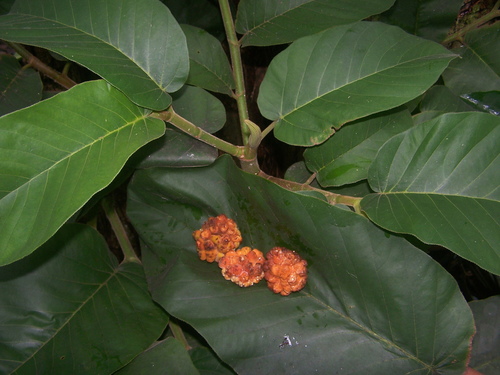
Panama rubber tree
Castilla elastica
The legendary source of ancient Mesoamerican rubber, this tropical giant is a masterpiece of natural engineering and historical significance.
Quick Identification
Size
Typically reaches 10–30 meters (33–100 feet) in height with a trunk diameter up to 1 meter (3.3 feet)
Colors
Smooth grayish-brown bark; vibrant green upper leaf surfaces with lighter, brownish-fuzz on the undersides
Key Features
- Broad, oblong leaves up to 45cm long with fine hairs
- Smooth gray bark that secretes thick white latex when cut
- Distinctive circular scars on the trunk from self-pruning branches
- Large, spreading buttress roots in mature specimens
When You’ll See Them
Behavior
The Panama rubber tree is a fast-growing tropical giant known for its unique 'self-pruning' habit. Unlike many trees that retain dead wood, this species regularly sheds its lower branches, leaving behind characteristic eye-shaped scars on the trunk. This process allows the tree to focus its energy on upward growth to reach the canopy light. It is perhaps most famous for its role in history; it was the primary source of latex for the Olmec, Maya, and Aztec civilizations.
Ecologically, the tree shares a fascinating symbiotic relationship with the Moonflower vine (Ipomoea alba). The vine often climbs the Panama rubber tree, and ancient people discovered that mixing the juice of the vine with the tree's raw latex created a chemical reaction—vulcanization—that turned the sticky sap into a durable, bouncy rubber used for ceremonial balls and waterproof sandals.
While it is a hardy and dominant species in its native range, it is sensitive to cold. It interacts heavily with local wildlife, particularly during its fruiting season when the small, orange-red fruits attract a variety of birds and small mammals that help disperse its seeds throughout the forest floor.
EverydayEarth exclusive
Camera Tips
To capture the majesty of a Panama rubber tree, position your camera at a wide angle to encompass the broad buttress roots and the unique 'scars' on the trunk. Because these trees are often located in dense tropical environments, use a camera with a high dynamic range (HDR) setting to manage the sharp contrast between bright canopy light and the deep shadows of the forest floor. If you are interested in the tree's growth, a long-term time-lapse set to take one photo every 24 hours can reveal its rapid leaf expansion and branch shedding over several months.
For wildlife enthusiasts, the Panama rubber tree is a 'stakeout' plant. During the fruiting season, mount your camera roughly 5-10 feet up a neighboring tree or on a sturdy tripod facing the lower branches. This is the best way to capture high-definition footage of toucans, parrots, and capuchin monkeys that visit the tree to feed. Use a motion-trigger with a fast shutter speed, as these animal visitors move quickly through the foliage.
If you want to document the tree's famous latex, focus on a macro shot of the bark. You don't need to harm the tree; often, natural cracks or insect borings will cause small beads of white latex to well up. Set your camera to a close-focus or macro mode with a ring light to highlight the texture of the grayish bark against the brilliant white of the sap. This provides a stunning educational visual of the tree’s internal chemistry.
Placement is key for trail cameras. Look for a tree that has a clear 'drip line'—the area under the outer canopy. Placing a camera here facing the trunk at a 45-degree angle will capture both the architectural beauty of the tree and any ground-dwelling mammals, like agoutis or coatis, that forage for fallen fruit around the base. Ensure the lens is cleaned regularly, as the humidity of the rubber tree's preferred habitat can quickly lead to lens fogging.
Frequently Asked Questions
Record Panama rubber tree at your habitat
Connect a camera to start building your own species record — AI identifies every visitor automatically.