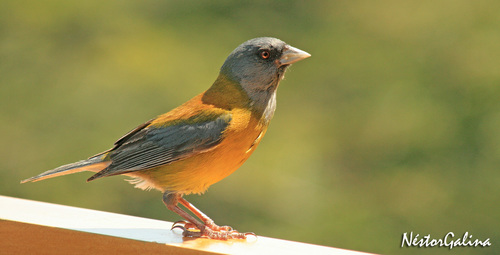
Patagonian Sierra-Finch
Phrygilus patagonicus
A vibrant splash of color in the southern wilderness, the Patagonian Sierra-Finch is the curious 'backyard buddy' of the Andes. With its slate-blue hood and warm orange back, it is one of the most charismatic birds you'll find on a southern trail camera.
Quick Identification
Size
Length: 15-16 cm (5.9-6.3 in); Weight: 18-25 g (0.6-0.9 oz)
Colors
Males feature a striking slate-blue hood, a cinnamon-brown back, and yellowish-green underparts. Females are duller with olive-green plumage and a faint gray wash on the head.
Key Features
- Distinctive slate-blue hood and neck
- Warm cinnamon or rusty-orange mantle
- Yellowish-olive belly and rump
- Dark, conical beak designed for seed-cracking
- Small, hopping gait while foraging
When You’ll See Them
Behavior
The Patagonian Sierra-Finch is a curious and social bird, often found in pairs or small family groups. Unlike many shy woodland species, these finches are relatively bold and have adapted well to human presence, frequently scavenging near campsites, trailheads, and rural gardens in search of easy meals. They move with a series of energetic hops, constantly flicking through leaf litter or low-hanging branches.
During the breeding season, males can be seen singing from prominent perches to defend their territory, delivering a series of sweet, whistling notes. They are primarily ground-foragers but are also agile enough to glean insects from foliage or hover briefly to reach berries. Their social nature makes them a frequent sight at communal water sources where they interact playfully with other small birds.
EverydayEarth exclusive
Camera Tips
To capture high-quality footage of the Patagonian Sierra-Finch, place your AI-powered camera low to the ground—ideally between 6 and 18 inches high. These birds spend the majority of their time foraging in the leaf litter, so a ground-level perspective provides an intimate view of their behavior. Choose a spot near the edge of a garden or a forest clearing where there is some natural cover like a shrub or woodpile nearby; this makes the birds feel secure enough to linger in front of the lens.
Using a lure is highly effective for this species. A shallow birdbath or even a simple drip system over a flat stone will act as a magnet, especially in drier spells. Alternatively, a small scattering of wild birdseed or crushed sunflower hearts on a mossy log can create a picturesque 'stage' for your camera. Since they are small and move quickly, ensure your camera is set to its highest motion sensitivity and use a fast trigger speed to avoid capturing just a blur of feathers as they hop away.
Morning light is your best friend when filming this species. Position your camera facing north or south to avoid direct lens flare, allowing the early sun to illuminate the rich cinnamon tones of the male's back and the soft blue of his hood. If you are using a camera with adjustable focal lengths, set it for a close-up (macro) range, as these birds are often comfortable approaching within a few feet of stationary objects. In winter, keep your camera active near feeders, as they become much more frequent visitors to residential areas when wild food sources are buried under snow.
Similar Species
Species that look similar or are commonly confused with Patagonian Sierra-Finch.
Frequently Asked Questions
Record Patagonian Sierra-Finch at your habitat
Connect a camera to start building your own species record — AI identifies every visitor automatically.