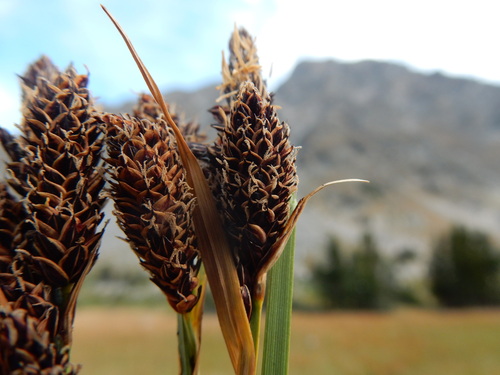
Payson's sedge
Carex paysonis
A hardy gem of the high country, Payson's sedge anchors the soil of alpine meadows with its striking dark-colored spikes and resilient tufted foliage.
Quick Identification
Size
Stands 4 to 16 inches (10 to 40 cm) tall; leaves are 2 to 6 mm wide
Colors
Bright green to glaucous-blue foliage; dark chocolate-brown to purplish-black flower spikes with cream-colored stigmas
Key Features
- Triangular stems typical of sedges
- Densely tufted growth pattern with short rhizomes
- Terminal spikes are dark brown or blackish
- Broadly elliptical fruit (perigynia) with a short beak
When You’ll See Them
Behavior
Payson's sedge is a resilient perennial that thrives in the demanding environments of high-elevation meadows and alpine slopes. Unlike many garden grasses, it grows in distinct, sturdy clumps and uses a network of underground rhizomes to stabilize itself against harsh mountain winds and shifting rocky soils. It plays a vital role in its ecosystem by preventing erosion and providing a micro-habitat for small alpine insects.
As a wind-pollinated species, it doesn't rely on flashy petals to attract bees; instead, it sends up slender stalks topped with dark, concentrated spikes that release pollen into the mountain breeze. While it may seem stationary, its growth is a slow-motion dance with the short alpine summer, rapidly blooming and seeding during the brief window when the snow melts.
EverydayEarth exclusive
Camera Tips
Capturing the subtle beauty of Payson's sedge requires a different approach than filming mobile wildlife. To see this plant in action, set your AI-powered camera to 'Time-Lapse' mode. Position the camera on a low tripod or a ground stake, roughly 12 to 18 inches from the base of a healthy clump. This perspective highlights the unique triangular stem and the intricate texture of the dark seed heads as they sway in the wind.
Because this species lives in bright, high-altitude environments, lens flare can be an issue. Angle your camera facing North or South to avoid the direct glare of the rising or setting sun, which can wash out the deep browns of the flower spikes. If your camera allows for macro settings or has a close-focusing distance, use it to capture the 'shaggy' appearance of the cream-colored stigmas that emerge during the peak flowering weeks in mid-July.
While the plant itself is the star, these sedges are often visited by pikas and marmots who use them for forage or nesting material. To capture these interactions, set your trigger sensitivity to 'High' and ensure the camera is low to the ground. If you are placing a camera in a backyard rock garden to monitor this species, a side-lit angle during the 'golden hour' (late afternoon) will emphasize the glaucous, silvery-green texture of the leaves against the dark soil.
Similar Species
Species that look similar or are commonly confused with Payson's sedge.
Frequently Asked Questions
Record Payson's sedge at your habitat
Connect a camera to start building your own species record — AI identifies every visitor automatically.