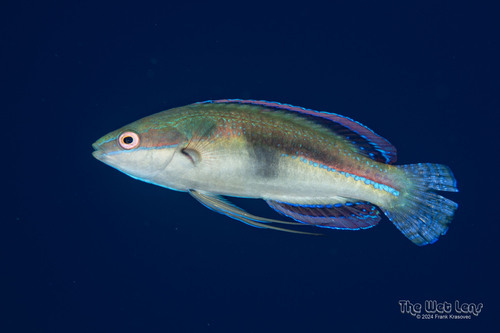
Peacock Wrasse
Cirrhilabrus temminckii
A shimmering jewel of the Indo-Pacific reefs, the Peacock Wrasse is famous for its electric 'flashing' displays. Discover how to record the vibrant colors and social life of this mesmerizing fairy wrasse.
Quick Identification
Size
Typically 3 to 4.5 inches (8 to 11.5 cm) in length
Colors
Males are vibrant with red or orange bodies and a brilliant iridescent blue or white stripe along the side; females are more uniform pinkish-red
Key Features
- Elongated dorsal fin with colorful filaments
- Iridescent blue or white longitudinal stripe
- Rapid, darting swimming motion above reef structures
When You’ll See Them
Behavior
The Peacock Wrasse, also known as Temminck’s Fairy Wrasse, is a high-energy socialite of the reef water column. Primarily diurnal, these fish spend their daylight hours patrolling just above the substrate or reef edge, darting into the flow to catch tiny drifting prey. They are highly social and are typically found in harems consisting of one dominant male and several females or juveniles.
The most spectacular behavior of the Peacock Wrasse is the 'flashing' display performed by males. During courtship or territorial disputes, the male can almost instantly intensify his colors, making his iridescent scales glow with neon brilliance while flaring his fins to appear larger. While they are active and bold when feeding, they are extremely wary of predators and will dive into the protection of coral crevices or rubble at the first sign of danger.
EverydayEarth exclusive
Camera Tips
To capture high-quality footage of the Peacock Wrasse, you will need a specialized underwater camera setup. Since these fish inhabit reef slopes and rubble zones, the best approach is to use an action camera with a waterproof housing or a dedicated reef-observation camera mounted on a weighted tripod. Place your camera near a 'cleaning station' or a known congregation point—look for areas where the current brings in plenty of plankton, as this is where they spend the most time hovering.
Lighting is your greatest challenge underwater. As you go deeper, red and orange wavelengths are lost, which can make the Peacock Wrasse look dull and grey. Use a pair of wide-angle underwater video lights (at least 2000 lumens each) to bring out their true iridescent reds and blues. Position the lights at 45-degree angles away from the camera lens to minimize 'backscatter,' which occurs when the light reflects off particles in the water back into the lens.
Because Peacock Wrasses are incredibly fast swimmers, set your camera to a high frame rate, such as 60fps or 120fps at 4K resolution. This allows you to utilize slow-motion in post-production, which is often the only way to truly appreciate the male's flashing display. Use a wide-angle lens to capture the social dynamics of the harem, but try to stay within 2 feet of the subjects for maximum clarity. If you are using a trail-cam style trigger, ensure it is set to a high sensitivity as these fish move with sudden, jerky motions that can be hard for some sensors to trip.
For the best results, deploy your camera during the brightest part of the day (11 AM to 2 PM) to take advantage of natural light penetration. Avoid using large amounts of bait, as this may attract larger predatory groupers or snappers that will scare the wrasses into hiding. A small amount of frozen mysis shrimp placed in a fine mesh bag can encourage the colony to stay in front of the lens without creating a 'feeding frenzy' that ruins the shot. Be prepared to leave the camera in place for at least 30 minutes to allow the fish to acclimate to its presence.
Frequently Asked Questions
Record Peacock Wrasse at your habitat
Connect a camera to start building your own species record — AI identifies every visitor automatically.