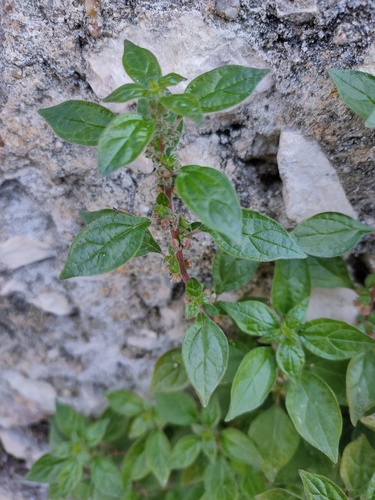
pellitory-of-the-wall
Parietaria judaica
A resilient urban survivor, Pellitory-of-the-wall turns stone cracks into thriving ecosystems. Known for its sticky leaves and role as a butterfly host, it is a fascinating example of nature reclaiming the concrete jungle.
Quick Identification
Size
Height 30-80 cm (12-31 in); Spread up to 1 m (3.3 ft)
Colors
Green to grayish-green foliage; stems are frequently pinkish-red or brownish; flowers are tiny and greenish-white.
Key Features
- Sticky, non-stinging hairs on stems and leaves
- Lance-shaped leaves with smooth margins and pointed tips
- Clusters of tiny, stalkless flowers in leaf junctions
- Spreading or scrambling growth habit often seen in wall cracks
When You’ll See Them
Geographic range
Where Does the pellitory-of-the-wall Live?
Native to the Mediterranean basin, North Africa, and parts of Western Asia, Pellitory-of-the-wall has become a globetrotting species. It is now widely naturalized across Western and Central Europe, the United Kingdom, and Ireland. Beyond its native continent, significant introduced populations thrive in Australia, New Zealand, and North and South America, particularly in coastal regions and temperate urban centers where stone architecture provides a familiar habitat.
Basemap © OpenStreetMap contributors
Behavior
While often viewed as an urban weed, it serves a vital ecological role by providing a habitat and food source for various insects. It is a primary host plant for the larvae of the Red Admiral butterfly. The plant is also famous for its 'explosive' pollination method, where the stamens spring outward when ripe, launching clouds of pollen into the air to be carried by the wind.
EverydayEarth exclusive
Camera Tips
Capturing Pellitory-of-the-wall requires a shift in perspective compared to mobile wildlife. To get the best results from your AI-powered camera, mount the device at a low angle or directly against a stone wall or rockery. This 'ground-level' view highlights the plant's unique architectural growth. If your camera has a macro mode or adjustable focus, set it to capture the intricate details of the leaf axils where the tiny, clustered flowers bloom, as these are key for AI identification.
Since this plant is a favorite host for the Red Admiral butterfly, position your camera near a healthy patch during the late spring and summer. Set your trigger sensitivity to high to capture the movement of caterpillars or the brief landings of adult butterflies. Using a time-lapse setting is especially rewarding; it can document the plant's rapid vertical climb and the way it responds to sunlight over the course of several weeks, turning a static weed into a dynamic subject.
For high-quality documentation, avoid using a direct flash at night, which can create harsh reflections on the 'sticky' hairs and wash out the subtle red tones of the stems. Instead, utilize the soft, diffused light of the early morning. This is also when the plant is most likely to release its pollen clouds, which can look spectacular when backlit by the sun. If you are placing a camera in a public or suburban area to track this species, ensure it is secured to a stable surface like a brick wall or wooden fence where the plant is established.
Frequently Asked Questions
Record pellitory-of-the-wall at your habitat
Connect a camera to start building your own species record — AI identifies every visitor automatically.