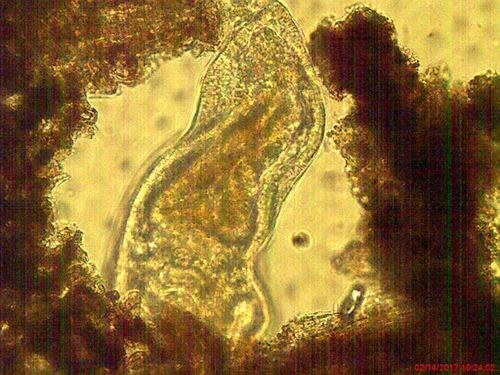
Pelomyxa
Pelomyxa palustris
The giant of the microscopic world, Pelomyxa is a massive, multi-nucleated amoeba that roams the muddy depths of backyard ponds. This ancient scavenger plays a vital role in recycling organic matter in low-oxygen environments where few other creatures can survive.
Quick Identification
Size
500–800 μm to 5 mm (0.02 to 0.2 inches)
Colors
Translucent gray, cloudy white, or muddy brown; often appears dark or speckled due to ingested sand and organic debris.
Key Features
- Giant single-celled body visible to the naked eye
- Lacks mitochondria and moves via slow cytoplasmic streaming
- Multiple nuclei and internal sand grains
- Slug-like, cylindrical shape when moving
When You’ll See Them
Geographic range
Where Does the Pelomyxa Live?
Pelomyxa is a cosmopolitan organism found across nearly every continent, thriving wherever stagnant freshwater and organic-rich sediments occur. It is most frequently documented in the temperate regions of North America and Europe, but it also has a significant presence throughout Northern Asia and parts of the Southern Hemisphere. Because it lives in the mud at the bottom of ponds, its presence is often overlooked, but it is a staple resident of healthy, low-oxygen wetland ecosystems worldwide.
Basemap © OpenStreetMap contributors
Behavior
Pelomyxa, often called the giant amoeba, is a fascinating microorganism that behaves more like a slow-motion scavenger than a typical single-celled organism. Unlike most life forms you might find in a pond, Pelomyxa is anaerobic, meaning it thrives in environments with little to no oxygen. It spends its life at the very bottom of stagnant water bodies, creeping through the thick, black muck where other creatures might suffocate.
Its movement is incredibly slow, characterized by a steady, fountain-like flow of its internal contents. It doesn't have the typical "arms" (pseudopods) seen in smaller amoebas; instead, it moves as one massive, undulating mass. Interestingly, it maintains a unique social relationship with bacteria that live inside its body, which help it process energy in the absence of traditional organelles like mitochondria.
EverydayEarth exclusive
Camera Tips
Capturing Pelomyxa on camera requires a specialized macro or microscopic setup, as these giants of the microbial world are right at the limit of human vision. For best results, use an AI-powered camera equipped with a high-magnification macro lens (at least 1:1 or 2:1 ratio). Position your observation chamber—ideally a thin glass slide or a specialized flow-cell—in an area with consistent, indirect light. Because they are translucent, using 'darkfield illumination' (lighting from the side against a dark background) will make their internal structures and sand grains glow beautifully.
To attract Pelomyxa to your lens, take a sample of the 'black muck' from the very bottom of a stagnant backyard pond. Place a small amount of this sediment in your viewing area and add a drop of pond water. You don't need traditional bait, but adding a tiny fragment of a decaying lily pad can encourage them to emerge from the debris to feed. Set your camera to take time-lapse photos or high-definition video; because their movement is so slow, a standard 30fps video might look like a still photo. A time-lapse of one frame every 5-10 seconds will reveal their graceful, streaming motion.
Since Pelomyxa is sensitive to bright, hot lights, use cool LED illumination to prevent overheating the water sample. If you are using a backyard 'smart pond' monitor, ensure the sensor is placed in the silty transition zone where the water meets the mud. This is their primary hunting ground. Late spring and summer are the best times for sampling, as the bacterial activity they depend on is at its peak in warmer, stagnant water.
Frequently Asked Questions
Record Pelomyxa at your habitat
Connect a camera to start building your own species record — AI identifies every visitor automatically.