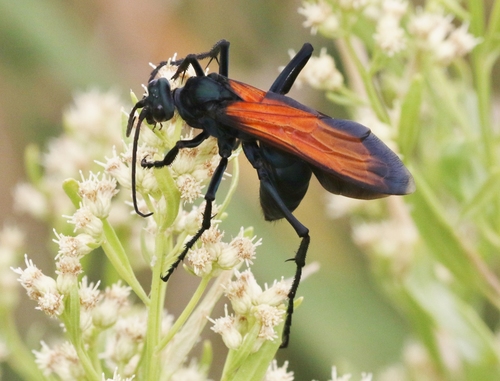
Pepsis grossa
Pepsis grossa
The Tarantula Hawk is a shimmering titan of the insect world, famous for its vivid orange wings and a legendary sting. As the state insect of New Mexico, this giant wasp is a spectacular example of desert specialization and beauty.
Quick Identification
Size
Body length of 1.5 to 2 inches (38–51 mm); wingspan can reach 3 inches (76 mm)
Colors
Metallic blue-black body; wings are typically bright 'xanthic' orange with dark margins, though some individuals possess 'melanic' solid black wings
Key Features
- Large, iridescent blue-black body
- Bright orange or deep black wings
- Extremely long, hooked legs with spines
- Females have curled antennae, while males have straight antennae
When You’ll See Them
Behavior
The Pepsis grossa, or Tarantula Hawk, is a solitary wasp known for its specialized and dramatic life cycle. Despite their intimidating size and reputation, they are not naturally aggressive toward humans. They spend most of their day foraging for nectar on flowering plants. However, the female's behavior changes when it is time to provide for her offspring; she becomes a calculated hunter, seeking out tarantulas in their burrows by detecting their scent.
When a female locates a tarantula, a fierce battle ensues. The wasp uses her powerful sting to paralyze the spider instantly. Once immobilized, she drags the much heavier spider back to a burrow, lays a single egg on its abdomen, and seals the entrance. The larva then consumes the paralyzed spider over several weeks. In the social sphere, males are often seen 'hilltopping,' which involves defending high ground on shrubs or trees to attract passing females.
To humans, these wasps are generally docile unless handled. They are often described as 'clumsy' fliers due to their large size, making a distinct clicking or humming sound while in flight. While their sting is famously painful—ranking as the second most painful insect sting in the world—the effect is short-lived, usually subsiding within five to ten minutes with no permanent damage.
EverydayEarth exclusive
Camera Tips
Capturing the Tarantula Hawk on camera requires a focus on their favorite fueling stations. Because adults are nectar-driven, the most successful camera placements are directed at flowering milkweed (Asclepias), fennel, or mesquite blossoms. Set your camera at a height of 12 to 24 inches, angled slightly upward to capture the sunlight hitting the wasp's metallic blue-black body, which creates a stunning iridescent effect in high-definition video.
Since these wasps are highly active and move with rapid, twitchy motions, your camera settings are critical. Use a high shutter speed or a frame rate of at least 60fps to prevent motion blur. If you are using a trail camera, look for models with a 'macro' or 'close-focus' lens capability, as standard trail cams often have a focal point too far away for small insects. Positioning the camera within 18 inches of a flower cluster is ideal, but ensure the background is not too cluttered so the AI can easily distinguish the wasp's silhouette.
Seasonality and timing are everything. You are most likely to trigger your camera during the hottest part of the day in mid-summer. Unlike many animals that retreat from the heat, Pepsis grossa thrives in it. If you have active tarantula burrows on your property (identifiable by silk-lined holes in the ground), placing a camera 2 feet away from the entrance can result in incredible 'action' footage of a female hunting or dragging her prey, though this requires more patience than flower-station monitoring.
Lighting can be a challenge due to their dark, reflective bodies. Avoid placing cameras where they will face the direct afternoon sun, which can cause 'blown-out' highlights on the wings. Instead, aim for filtered light or side-lighting, which emphasizes the texture of their wings and the deep blues of their thorax. During periods of extreme drought, a shallow water dish with stones for landing can also serve as an excellent lure for capturing these giants on film.
Frequently Asked Questions
Record Pepsis grossa at your habitat
Connect a camera to start building your own species record — AI identifies every visitor automatically.