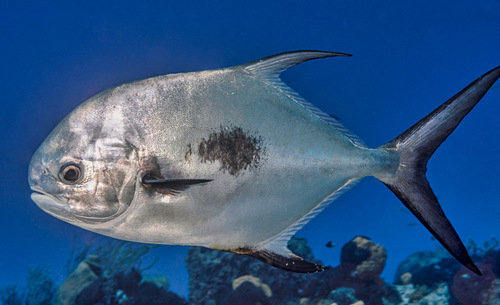
Permit
Trachinotus falcatus
The ghost of the flats, the Permit is a master of camouflage and speed. Watch for the flash of silver and the iconic scythe-like fins as this coastal heavyweight patrols the shallows.
Quick Identification
Size
24-36 inches (60-91 cm) in length; 20-35 lbs (9-16 kg), though trophy specimens can exceed 50 lbs
Colors
Brilliant silver flanks with an iridescent blue-green back; a faint yellow or orange smudge is often visible on the belly near the anal fin; fins are typically dark or dusky.
Key Features
- Deeply compressed, disc-shaped body profile
- Tall, sweeping dorsal and anal fins that resemble scythes
- Deeply forked tail with a dark trailing edge
- Small, toothless mouth designed for suction and crushing
- Smooth, tiny scales giving a metallic sheen
When You’ll See Them
Sightings on EverydayEarth
Apr 18, 2026
A vibrant reef scene shows several species of fish active among the corals and sea fans. Atlantic Sergeant Majors and Bluehead Wrasse are the most prominent, hovering and darting near the reef. An Atlantic Blue Tang briefly passes through the center of the frame, and a larger Permit is seen swimming quickly in the distance through the open water.
Mar 31, 2026
The footage begins with a view of a brain coral and sea fans swaying in the current in a shallow, sandy-bottomed area of the reef. The scene then shifts to a deeper reef wall where a school of Permit swims gracefully through the water column, followed by a few smaller reef fish, including a blue tang, navigating the coral outcrops.
Mar 30, 2026
A busy reef scene on a steep wall. Initially, two large Permit swim across the upper frame. A French Angelfish then approaches and investigates the camera lens closely, showing its intricate scale patterns. A yellow-phase Bluehead Wrasse darts through the foreground. Finally, a large shark swims past the camera, opening its mouth wide in a gape toward the lens.
Behavior
Permit are legendary among coastal observers for their wary and unpredictable nature. They are highly intelligent fish with exceptional eyesight, often seen 'tailing' in shallow water—a behavior where their caudal fin pokes through the surface as they root through the sand for prey. While juveniles often form large, energetic schools in the surf zone for protection, adults tend to be more solitary or travel in small, elite pods of three to five individuals.
These fish are perfectly adapted to the 'flats'—shallow, sun-drenched coastal zones where they navigate with surprising speed. They are notorious for being easily spooked; even a shadow or a splash can send a pod of Permit racing for deeper water. Despite this skittishness, they are curious and will occasionally approach stationary objects or docks to investigate potential food sources stirred up by the current.
EverydayEarth exclusive
Camera Tips
Capturing a Permit on camera requires a specialized approach because they are aquatic and exceptionally cautious. For the best results, use an underwater action camera or a submersible trail camera mounted to a weighted base. Position your camera at the edge of a seagrass bed or near a sandy 'pothole' where the tide naturally funnels water. Permit often travel against the current, so face your lens toward the oncoming tide to catch them swimming directly into the frame. Mount the camera as low as possible, about 6-12 inches off the seabed, to capture their iconic 'disc' profile against the light filtering from the surface.
If you have a backyard dock or a coastal canal, you can significantly increase your chances of a 'visit' by providing structural interest or scent. Permit are attracted to areas where crabs and shrimp congregate. You can create a natural lure by crushing a few blue crabs and placing them in a mesh bait bag just out of the camera's view; the scent trail will draw them in from a distance. If filming from above the water, a circular polarizer filter is mandatory to cut through the surface glare and reveal the fish moving underneath.
Because Permit have highly reflective silver scales, they are prone to 'flaring' or overexposing in bright sunlight. Set your camera’s exposure compensation to -0.5 or -1.0 to preserve the iridescent details of their skin. Use a high frame rate (at least 60fps) because their movements are lightning-fast; a standard 24fps or 30fps setting may result in motion blur when they turn or accelerate. If your camera has a 'wide-angle' setting, use it to maximize the field of view in the relatively low-visibility environment of the water.
Lastly, timing is everything. The 'flood tide' (incoming) usually brings the clearest water and the most active foraging behavior. Plan your camera checks around the lunar cycle; the days leading up to the new and full moons often see the most dramatic 'tailing' action in the shallows. In suburban canal settings, night-time filming is possible using green underwater lights, which attract the baitfish and crustaceans that Permit hunt, though they remain significantly more active during the daylight hours.
Similar Species
Species that look similar or are commonly confused with Permit.
Frequently Asked Questions
Record Permit at your habitat
Connect a camera to start building your own species record — AI identifies every visitor automatically.