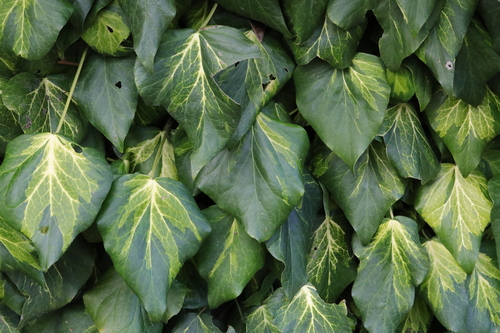
Persian Ivy
Hedera colchica
The 'King of Ivies,' Persian Ivy brings a lush, tropical feel to temperate gardens with its massive, heart-shaped leaves. A hardy survivor, it provides a vital winter larder for birds when the rest of the world is frozen.
Quick Identification
Size
A vigorous climber reaching up to 30 m (98 ft) in height; leaves are 15-25 cm (6-10 in) long and 10-20 cm (4-8 in) wide.
Colors
Deep matte green leaves, occasionally variegated with cream or gold in garden cultivars; small yellowish-green flowers; dull black berries.
Key Features
- Large, leathery heart-shaped leaves
- Crushed leaves produce a distinct sulfur or celery-like scent
- Climbs via sticky aerial rootlets
- Berries turn black when ripe in late winter
When You’ll See Them
Behavior
Persian Ivy is a robust, evergreen woody climber known for its incredible speed of growth once established. Unlike its cousin, the English Ivy, it features much larger, thicker leaves that have a characteristic drooping appearance. It exhibits two distinct growth phases: the juvenile stage, where it uses aerial rootlets to scale vertical surfaces or spread as ground cover, and the adult stage, which occurs once the plant reaches the top of its support. In the adult phase, it produces non-climbing woody branches that bear flowers and fruit.
In a backyard ecosystem, Persian Ivy acts as a structural architect. It provides dense, year-round cover for small mammals and nesting sites for birds. Because it thrives in shade, it often colonizes the darker corners of gardens where other plants struggle. While it is a vigorous grower, it is generally less invasive than English Ivy in many regions, though it still requires regular pruning to keep it from overtaking trees or masonry.
EverydayEarth exclusive
Camera Tips
Capturing the beauty of Persian Ivy requires a different approach than moving wildlife. To see the plant 'in action,' set your AI camera to time-lapse mode. Because Persian Ivy is one of the fastest-growing Hedera species, an interval of one photo every 24 hours over a single growing season can create a stunning visual record of its climbing progress. Aim the camera at a vertical trellis or a bare wall where the leading tendrils are active to see the aerial rootlets reaching out and gripping the substrate.
For those interested in traditional wildlife captures, Persian Ivy is a premier 'stage' for backyard birds. Its berries ripen in late winter (February and March) when other food sources are scarce. Position your camera 3-5 feet away from a cluster of black berries, using a slightly downward angle to capture birds like Robins, Thrushes, or Cedar Waxwings as they forage. Use a high shutter speed setting if your camera allows, as bird activity at fruit clusters can be erratic and fast-paced.
Because the leaves are dark green and leathery, they can easily become 'blown out' or overly reflective in direct midday sun. For the best photographic results, place your camera in a spot that receives dappled light or afternoon shade. This will emphasize the deep textures and veining of the foliage. If you are using a trail camera for night shots, the broad leaves can reflect IR flash, creating white hot-spots in your images; try to angle the camera 45 degrees to the leaf surface rather than head-on to reduce glare.
Lastly, don't overlook the macro potential. The large leaves of Persian Ivy are often home to specialized insects and spiders. If your camera has a close-focus or macro lens capability, mount it near the underside of the leaves during the summer months. You can often capture the hidden world of predatory spiders or beneficial insects that use the ivy’s dense canopy as a hunting ground, providing a unique look at your garden's micro-ecosystem.
Frequently Asked Questions
Record Persian Ivy at your habitat
Connect a camera to start building your own species record — AI identifies every visitor automatically.