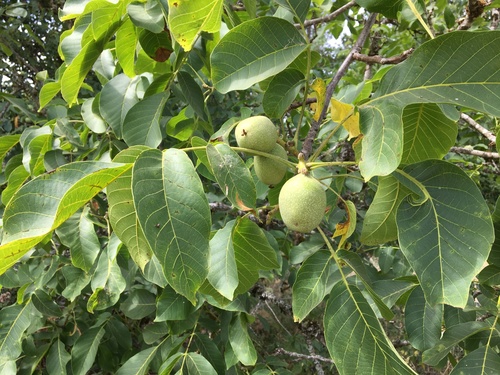
Persian walnut
Juglans regia
The Persian walnut is a majestic landscape staple that offers more than just delicious nuts; it’s a bustling high-rise apartment for backyard wildlife. With its sprawling canopy and silver-grey bark, this ancient tree brings a touch of history and a wealth of biodiversity to any garden.
Quick Identification
Size
Height: 25–35 m (80–115 ft); Canopy spread: 15–20 m (50–65 ft); Trunk diameter: up to 2 m (6.5 ft)
Colors
Silvery-grey bark on young trees, darkening to grey-brown with age; bright green foliage that turns golden-yellow in autumn; green fruit husks.
Key Features
- Large, odd-pinnate leaves with 5–9 oval leaflets
- Smooth, silver-grey bark that develops deep fissures with age
- Large, fleshy green husks containing the edible walnut
- Leaves release a distinctive citrus-spicy scent when crushed
When You’ll See Them
Behavior
The Persian walnut is a long-lived, deciduous powerhouse that acts as a central hub for backyard ecosystems. Unlike many other trees, it exhibits 'allelopathy,' releasing a chemical called juglone into the soil from its roots and fallen leaves. This natural herbicide reduces competition by inhibiting the growth of certain other plants nearby, effectively carving out its own territory in your garden.
As a resource for wildlife, the tree is incredibly generous. In the spring, its catkins provide pollen for insects, while the dense summer canopy offers nesting sites for a variety of songbirds. By autumn, the tree enters its most active phase for wildlife watchers, as its heavy crop of nutrient-dense nuts becomes a primary food source for mammals and large birds preparing for winter.
EverydayEarth exclusive
Camera Tips
To capture the best action on a Persian walnut tree, focus your camera on the 'main highway' branches. Squirrels and chipmunks will frequently use the same large, horizontal limbs to transport nuts to their caching sites. Mount your camera 5–8 feet up the trunk facing one of these primary branches, using a side-angle to capture the animal's full profile as it carries a bulky green husk in its mouth.
If you are interested in the nut-harvesting process, place a camera on a tripod roughly 10 feet away from the base of the tree during September and October. Many nuts will fall to the ground, attracting ground-dwelling foragers like deer, turkeys, and even foxes. Ensure your camera is set to a fast trigger speed or 'burst mode,' as the squirrels moving through the leaf litter can be remarkably quick when they are competing for fallen prizes.
For those with AI-powered cameras, the Persian walnut is an excellent spot to set up a 'bird station' in the canopy. Aim your camera at a cluster of nuts near the outer edge of the branches. Woodpeckers and Nuthatches are frequent visitors, often wedging the nuts into bark crevices to hammer them open. Because the canopy can be dark, look for a spot that catches the morning sun to ensure your AI can accurately identify the fast-moving feathers of your visitors.
Seasonal time-lapse is another fantastic use for a camera dedicated to a Persian walnut. Because these trees have such a dramatic transformation—from bare, silver limbs in winter to lush green in summer and golden in fall—a single photo taken at the same time each day can create a stunning visual record of your backyard's changing seasons. Use a permanent mount to ensure the frame remains consistent throughout the year.
Similar Species
Species that look similar or are commonly confused with Persian walnut.
Frequently Asked Questions
Record Persian walnut at your habitat
Connect a camera to start building your own species record — AI identifies every visitor automatically.