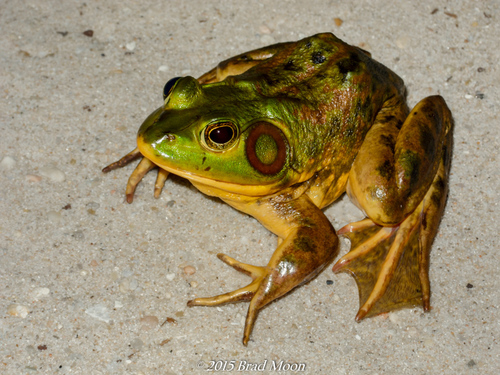
Pig Frog
Lithobates grylio
A master of the Southern swamp, the pig frog is famous for its pig-like grunts and its ability to vanish into the lily pads at a moment's notice.
Quick Identification
Size
3.25 to 6.5 inches (8.2 to 16.5 cm); 100 to 350 grams
Colors
Green, olive, or brownish-black with dark spotting; creamy white or yellowish belly with dark, net-like (marmorated) patterns; males often have bright yellow throats during breeding
Key Features
- Webbing on hind feet extends to the very tips of the toes
- Pointed snout profile
- Distinctive guttural 'uink-uink' grunting call
- Large, prominent tympanum (eardrum) often larger than the eye
- Dark net-like patterns on the belly and inner thighs
When You’ll See Them
Geographic range
Where Does the Pig Frog Live?
Native to the North American continent, the pig frog is a specialist of the humid Southeastern United States. Its core range is concentrated along the Atlantic and Gulf Coastal Plains, stretching from the southern tip of South Carolina down through the entirety of Florida and westward to the eastern edge of Texas. This species is almost never found far from the warm, permanent wetlands of the Deep South, thriving in the vast swamp networks of Georgia, Alabama, Mississippi, and Louisiana.
Basemap © OpenStreetMap contributors
Behavior
The pig frog is a highly aquatic species that rarely ventures far from the water's edge, preferring to spend its life floating among lily pads or perched on cypress knees. They are intensely solitary and territorial, particularly the males, which establish calling stations in deep water to attract females. Unlike many other frogs that may be found in damp woods, the pig frog's anatomy—specifically its fully webbed feet—makes it a powerful swimmer but somewhat clumsy on land.
Primarily nocturnal, these frogs spend their days in a state of 'quiet alert,' blending perfectly with floating vegetation. When darkness falls, they become formidable ambush predators. While they are famously shy and will dive at the slightest vibration or shadow, their presence is easily announced by their rhythmic, pig-like grunting choruses that can carry long distances across a quiet swamp. In human-populated areas, they are usually only seen by those with boats or boardwalks that extend into their deep-water habitats.
EverydayEarth exclusive
Camera Tips
To successfully capture a pig frog on camera, you must focus on the water. Because they are almost entirely aquatic, standard trail camera setups on trees will likely miss them. Use a low-profile stake or a custom floating mount to position your camera just 6 to 12 inches above the water level, aimed toward floating vegetation like lily pads or water hyacinths. This 'frog's eye view' provides the most engaging footage and ensures the motion sensor picks up their subtle movements.
Since these frogs are nocturnal, your camera's infrared (IR) performance is critical. Look for a camera with 'No-Glow' or 'Low-Glow' IR to avoid startling the frogs, though pig frogs are generally less sensitive to IR light than mammals. Set your camera to 'Photo + Video' mode; the photo captures the immediate action, while the video allows you to hear their unique grunting calls, which is one of the most rewarding aspects of monitoring this species. Use a high-sensitivity trigger setting, as a frog sitting still on a lily pad offers a very small heat signature.
A unique trick for attracting pig frogs is to use a light lure. A very dim, battery-powered LED light placed near the water's surface (but not directly in the camera's field of view) will attract nocturnal insects like moths and beetles. The pig frogs will naturally gravitate toward this 'buffet,' providing you with consistent opportunities to record hunting behavior. For the best results, deploy your gear during the humid summer months, specifically on nights following a heavy afternoon rainstorm when activity levels are at their peak.
Similar Species
Species that look similar or are commonly confused with Pig Frog.
Frequently Asked Questions
Record Pig Frog at your habitat
Connect a camera to start building your own species record — AI identifies every visitor automatically.