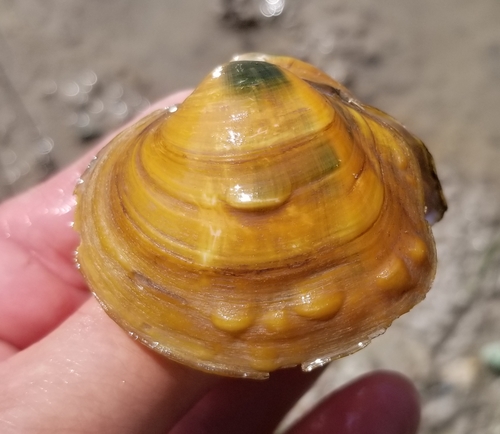
Pimpleback
Pustulosa pustulosa
A master of the riverbed, the Pimpleback is a bumpy, heavy-shelled mussel that serves as a vital indicator of water health across North America's great river systems.
Quick Identification
Size
3 to 4 inches (7.6 to 10.2 cm) in length; typically weighs between 5 and 10 ounces (140 to 280 grams).
Colors
Exterior ranges from yellowish-brown to dark chestnut brown; interior nacre is pearly white; often features a single broad, faint green ray on the umbo area.
Key Features
- Rounded to squarish shell profile
- Surface covered in numerous distinct bumps or 'pustules'
- Thick, heavy shell with a deep beak cavity
- No teeth in the front of the shell, but heavy lateral teeth
When You’ll See Them
Geographic range
Where Does the Pimpleback Live?
The Pimpleback is a native resident of North America, primarily concentrated throughout the vast Mississippi River drainage basin. Its territory spans from the Great Lakes region in the north, including parts of the St. Lawrence River system in Canada, down to the Gulf of Mexico. It is widely distributed across the eastern and central United States, found in high densities in states like Tennessee, Ohio, and Missouri.
Basemap © OpenStreetMap contributors
Behavior
The Pimpleback is a sedentary freshwater mussel that lives a largely subterranean life on the river floor. It spends its time partially buried in the substrate, using a muscular 'foot' to anchor itself against the current. As a filter feeder, it plays a critical role in the aquatic ecosystem by drawing in water and filtering out algae, plankton, and organic debris, essentially acting as a natural filtration system for our waterways.
The reproductive strategy of the Pimpleback is remarkably complex and dependent on local fish populations. The female releases larvae, known as glochidia, which must attach themselves to the gills or fins of a host fish—specifically catfish like the Channel Catfish or Flathead Catfish—to survive their first stage of life. After a few weeks of hitchhiking, they drop off and settle into the riverbed to grow into adults, a process that can take several years before they reach maturity.
While they may seem inactive to the casual observer, Pimplebacks are sensitive to their environment. They can close their shells tightly in response to predators or poor water conditions. In a backyard river setting, they are most often discovered not by seeing the living animal, but by finding the 'middens' or shell piles left behind by hungry muskrats and raccoons along the shore.
EverydayEarth exclusive
Camera Tips
Capturing a Pimpleback on camera requires a specialized approach, as these creatures live entirely underwater. For the best results, use a waterproof action camera or a dedicated underwater trail camera. Place the camera on a weighted base or a low-profile tripod in shallow, clear sections of a river or creek where the bottom consists of mixed gravel and sand. Position the lens at a downward 45-degree angle to focus on the riverbed, looking for the characteristic 'keyhole' openings of mussel siphons.
Since mussels move very slowly, traditional motion-activated sensors will rarely trigger. Instead, set your camera to time-lapse mode, taking a photo every 5 to 10 minutes. This allows you to observe the subtle opening and closing of the shell and the extension of the siphons as the mussel feeds. If you are using a standard trail camera above water, focus your efforts on 'mussel middens'—heaps of empty shells left on logs or banks by predators. This is an excellent way to document the species present in your backyard water source without getting the camera wet.
Clarity is the biggest challenge when filming the Pimpleback. Schedule your camera sessions during the summer months when water levels are low and the flow is gentler, which reduces turbidity. Avoid filming immediately after heavy rains, as the stirred-up silt will make the water too cloudy for a clear shot. Mid-day sun provides the best natural lighting for underwater shots, helping to reveal the intricate textures of the 'pimples' on the shell and the pearly white interior of any open specimens.
If you are filming at night, ensure your camera has an infrared or low-glow flash that works through water. Many mussels are more active in their siphoning during the quiet hours of the night when fish activity is lower. If you find a living specimen, do not move it for a photo; instead, clear away any loose debris or leaves from around it to get a better view of its natural position in the substrate.
Frequently Asked Questions
Record Pimpleback at your habitat
Connect a camera to start building your own species record — AI identifies every visitor automatically.