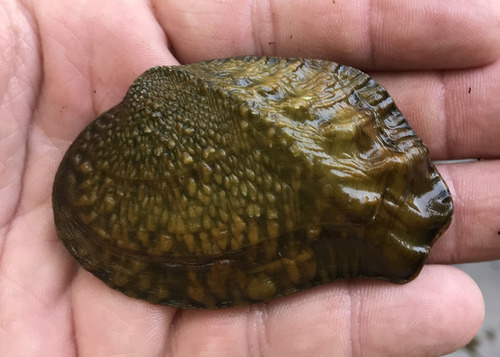
Pistolgrip
Quadrula verrucosa
The Pistolgrip is a master of disguise on the riverbed, sporting a rugged, bumpy shell that looks more like a piece of antique hardware than a living creature. This fascinating mollusk acts as a natural water purifier, spending its long life cleaning the very rivers it calls home.
Quick Identification
Size
Typically 4 to 8 inches (10–20 cm) in length; weight varies by shell thickness.
Colors
Exterior is dark olive, chestnut brown, or black; interior nacre is typically pearly white.
Key Features
- Distinctly elongated, rectangular shell resembling a handgun grip
- Surface covered in prominent, teardrop-shaped bumps or pustules
- Sharply angled posterior ridge
- Heavy, thick-walled shell structure
When You’ll See Them
Geographic range
Where Does the Pistolgrip Live?
The Pistolgrip is native to the North American continent, specifically throughout the vast Mississippi River drainage system. Its range extends from the Great Lakes region and the Saint Lawrence River basin in the north, stretching south to the Gulf of Mexico drainages in Texas and Louisiana. It is most commonly found in the central United States, particularly within the Ohio, Missouri, and Tennessee River systems.
Basemap © OpenStreetMap contributors
Behavior
The Pistolgrip is a sedentary freshwater mussel that spends most of its adult life partially buried in the riverbed. Unlike more mobile wildlife, its behavior is characterized by its role as a biological filter. By siphoning water through its mantle, it consumes microscopic particles while simultaneously cleaning the river. This makes the species an essential 'ecosystem engineer,' maintaining water clarity for other aquatic plants and animals.
Its social interactions are largely limited to its unique reproductive cycle. To ensure its larvae (glochidia) survive, the Pistolgrip must attract a specific host fish—usually the Flathead Catfish. The mussel releases its larvae into the water, which then attach to the fish's gills as harmless parasites for several weeks. Once developed, the juvenile mussels drop off the fish and settle into the substrate to begin their long, stationary lives.
EverydayEarth exclusive
Camera Tips
Capturing a Pistolgrip on camera requires a specialized aquatic approach, as these mussels are entirely submerged. To get a clear shot, use a waterproof action camera or a trail camera in a dedicated underwater housing. The best placement is in shallow, clear-running river bends where the water is no more than two feet deep. Secure your camera to a heavy flat stone or a weighted base to prevent the current from sweeping it away, and angle it slightly downward toward the substrate.
Timing is everything when filming mussels. While they don't move much, they are most visually interesting during their brooding season in late spring or summer. During this time, you might capture the mussel slightly more 'open' as it siphons water or attempts to attract host fish. Look for clear-water days following a period of no rain; sediment from storms will cloud your footage and hide the fine details of the mussel's pustules (the bumps on its shell).
For the best image quality, rely on natural sunlight during the middle of the day (10 AM to 2 PM) when the sun is directly overhead, as water absorbs light quickly. If you are filming in deeper or murkier water, an external LED dive light can help highlight the texture of the shell. Set your camera to a 'Macro' or close-focus mode if available, as the most fascinating part of the Pistolgrip is the intricate, bumpy texture that gives it its name.
Frequently Asked Questions
Record Pistolgrip at your habitat
Connect a camera to start building your own species record — AI identifies every visitor automatically.