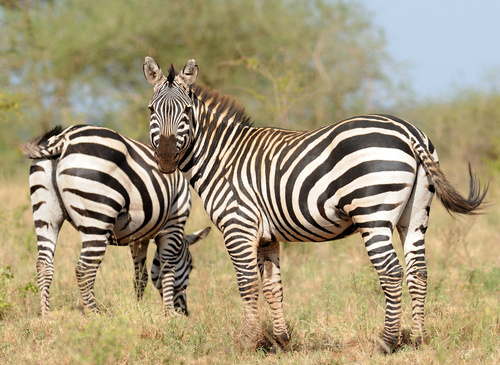
Plains Zebra
Equus quagga
The iconic 'painted horse' of Africa, the Plains Zebra is a masterpiece of natural geometry. Social, resilient, and strikingly beautiful, these grazers are a favorite for wildlife photographers and trail cam enthusiasts alike.
Quick Identification
Size
Shoulder height: 1.1–1.5 m (3.6–4.9 ft); Weight: 175–385 kg (385–850 lbs); Length: 2.1–2.5 m (7–8.2 ft)
Colors
Distinctive black and white vertical stripes on the body, transitioning to horizontal stripes on the legs; muzzle is black; mane is short and upright with alternating black and white tufts.
Key Features
- Broad black and white stripes that extend onto the belly
- Short, stiff, mohawk-like mane
- Solid black muzzle
- Horizontal leg striping that typically reaches the hooves
When You’ll See Them
Sightings on EverydayEarth
Aug 1, 2026
A small herd of Plains Zebras is gathered around a shallow pool of water. Several individuals are actively drinking, lowering their heads to the water, while others stand nearby. One zebra in the foreground occasionally lifts its head to look around, displaying typical alert behavior while the group is vulnerable at the water source.
Aug 1, 2026
A bustling scene at the waterhole features several Waterbuck drinking at the edge. In the background, a small herd of Plains Zebras and a lone Common Wildebeest are visible on the dry ground. A pair of Warthogs trots along the opposite bank, while a large Nile Crocodile rests motionless on the shoreline to the left.
Aug 1, 2026
A diverse group of animals has gathered at the waterhole under the bright morning sun. Several Common Wildebeest are wading and drinking in the shallow water, while a single Impala stands nearby. In the background, an African Savanna Elephant can be seen near the far left shore, and a small herd of Plains Zebras is gathered on the grassy bank to the right.
Jul 31, 2026
A small group of Plains Zebras is gathered in a clearing of tall, golden grass. One individual stands watchfully facing left, while three others are huddled together, occasionally lowering their heads to graze or flicking their tails in the morning sun.
Jul 31, 2026
A small herd of Plains Zebras is gathered in the center of the frame, milling about in the dry grass. In the background, several Blue Wildebeest are seen walking from right to left across the woodland clearing. The two species are often seen together in the African bushveld for mutual protection.
Jul 31, 2026
A group of Waterbuck are wading and foraging in the shallow waters of the waterhole. In the background, a large mixed herd of Plains Zebras and Common Wildebeests are seen moving across the dry, open grassland towards the water.
Behavior
Plains Zebras are highly social animals that live in stable, long-term family units known as harems. These groups typically consist of one dominant stallion, several mares, and their recent offspring. Unlike many other social mammals, these family bonds are incredibly strong; if a member of the group falls behind due to illness or injury, the rest of the harem will often slow their pace to wait for them. They are frequently seen in 'super-herds' alongside wildebeest and ostriches, a symbiotic relationship where the zebras use their keen eyesight and the wildebeest use their sense of smell to detect predators.
Communication within the herd involves a mix of facial expressions, body language, and vocalizations. The most famous sound is a high-pitched 'bray' that sounds like 'a-ha, a-ha, a-ha.' While they appear passive when grazing, zebras are notoriously feisty. Stallions will engage in violent battles for dominance, involving powerful kicks and neck-wrestling, and they are one of the few animals known to successfully fight off a lion through well-placed kicks.
EverydayEarth exclusive
Camera Tips
Capturing the perfect shot of a Plains Zebra requires an understanding of their daily commute. They are creatures of habit, typically moving from sleeping grounds to grazing areas at dawn and heading to water holes during the heat of the day. For the best results, place your camera along established 'game trails'—the narrow, well-worn dirt paths through the grass. Position the camera at chest height (about 3 to 4 feet) to ensure you capture the full body of the animal rather than just the legs or the top of the back.
Lighting is your biggest challenge with zebras. Their high-contrast coats often cause 'clipping' in digital sensors, where the white stripes appear as glowing blobs and the black stripes lose all detail. To combat this, avoid placing cameras in spots with dappled sunlight under heavy tree cover. Instead, choose open areas with consistent lighting. If your camera allows for exposure adjustment, slightly underexposing the image can help preserve the detail in those bright white stripes during the harsh midday sun.
One of the best ways to get prolonged footage is to set up your camera near a salt lick or a known watering hole. Zebras have a biological need for minerals and will spend several minutes at a lick, providing ample time for high-quality video. Because they travel in single-file lines, use 'Burst Mode' or a long video trigger (30 seconds or more). This ensures that if the lead stallion triggers the camera, you don't miss the mares and adorable foals following closely behind him.
Finally, consider the wind. While zebras are habituated to many sounds, the metallic click of some older trail camera models or the scent of a human can make them skittish. Use a camera with a 'No-Glow' or 'Black LED' flash to avoid startling them at night, and try to mount the camera using a security box or a high-tensile strap, as curious youngsters are known to nudge or lick equipment, which can knock your framing out of alignment.
Similar Species
Species that look similar or are commonly confused with Plains Zebra.
Frequently Asked Questions
Record Plains Zebra at your habitat
Connect a camera to start building your own species record — AI identifies every visitor automatically.