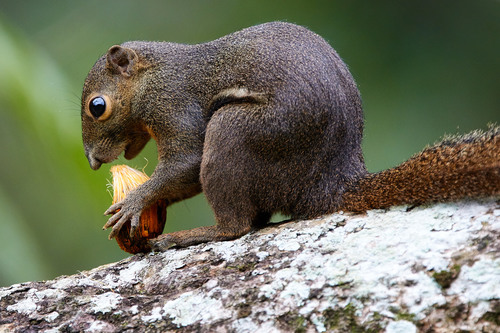
Plantain Squirrel
Callosciurus notatus
With its vibrant orange belly and striking side stripes, the Plantain Squirrel is the most colorful garden acrobat of Southeast Asia. Often seen darting through mango trees and across power lines, this resilient rodent is a master of suburban survival.
Quick Identification
Size
Length 20-28 cm (8-11 in), tail 15-25 cm (6-10 in); weight 150-400g (5-14 oz)
Colors
Brownish-grey upper body with a vibrant chestnut or reddish-orange belly. Distinctive black and buff-white stripes running along the sides.
Key Features
- Bright reddish-orange underparts
- Black and white/cream lateral stripes between the back and belly
- Long, bushy tail with grizzled appearance
- Medium build with large, dark eyes
When You’ll See Them
Geographic range
Where Does the Plantain Squirrel Live?
Native to the lush tropical regions of Southeast Asia, the Plantain Squirrel is a hallmark species of the Sundaland region. Its core range extends across the Malay Peninsula, including southern Thailand, and reaches deep into the archipelagos of Indonesia—specifically Sumatra, Java, Borneo, and Bali—as well as Singapore. While primarily found in its native tropical range, its high adaptability allows it to thrive in almost any environment from coastal mangroves to inland mountain foothills.
Basemap © OpenStreetMap contributors
Behavior
The Plantain Squirrel is a highly active and vocal acrobat of the treetops. Known for its loud 'chucking' alarm calls and frantic tail flicking, it is a frequent sight in Southeast Asian gardens, where it moves with incredible agility between branches. These squirrels are solitary for the most part but are often seen in pairs or small family groups near high-quality food sources.
They have adapted remarkably well to human environments, often treating garden fences and telephone wires as high-speed commuter routes. While they are charismatic, their fondness for cultivated fruits like mangos and jackfruit frequently puts them at odds with local farmers and gardeners, earning them a reputation as clever garden raiders that can peel a fruit right on the branch.
EverydayEarth exclusive
Camera Tips
To capture the best footage of the Plantain Squirrel, placement is everything. Since these are primarily arboreal animals, mounting your AI camera 5 to 10 feet up a tree trunk or on a fence post is much more effective than ground placement. Angle the camera slightly downward toward a horizontal branch or a known 'highway' they use to move between trees. They are creatures of habit and will often use the same path every morning at the same time.
While they are naturally curious, a little bait can go a long way. Use a smear of peanut butter on the bark of a tree or place a slice of jackfruit, mango, or even a piece of coconut within the camera's field of view. Be sure to secure the bait with a small biodegradable string so they don't simply carry the whole prize away in the first few seconds, allowing you to get a longer video of them feeding.
These squirrels are incredibly fast and twitchy, so look for camera settings with a high trigger speed or use video mode to catch their frantic movements. Because they are active during the brightest parts of the day, ensure your camera isn't facing directly into the rising or setting sun to avoid blown-out images. If you are using an AI-powered camera, the Plantain Squirrel's high-contrast side stripes and red belly are key identifiers that the system will pick up easily even in dappled forest light.
Similar Species
Species that look similar or are commonly confused with Plantain Squirrel.
Frequently Asked Questions
Record Plantain Squirrel at your habitat
Connect a camera to start building your own species record — AI identifies every visitor automatically.