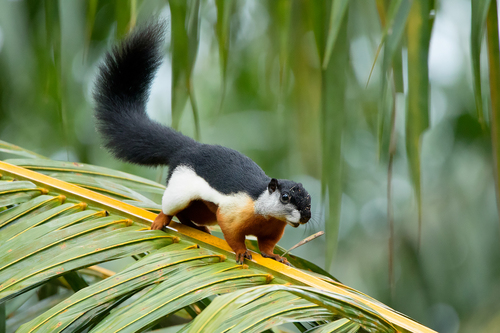
Prevost's Squirrel
Callosciurus prevostii
Often called the most beautiful squirrel in the world, the Prevost's squirrel is a master of the canopy. With its vibrant tri-colored coat and acrobatic personality, it is a favorite for backyard observers across Southeast Asia.
Quick Identification
Size
Body length of 20–28 cm (8–11 in), tail length of 20–28 cm (8–11 in), and weight between 250–500 g (9–18 oz)
Colors
Jet black upperparts and tail, rich reddish-chestnut underparts, and a distinct white lateral stripe separating the two
Key Features
- Striking tri-color pattern of black, white, and chestnut
- Long, bushy black tail nearly equal to body length
- White stripe running from the nose along the flanks to the hind legs
- Arboreal build with sharp claws for climbing
When You’ll See Them
Geographic range
Where Does the Prevost's Squirrel Live?
The Prevost's squirrel is a jewel of Southeast Asia, primarily found across the lush Thai-Malay Peninsula and the major islands of Sumatra and Borneo. Its range extends to numerous smaller surrounding islands, and it has successfully established an introduced population in northern Sulawesi. These squirrels are most at home in the humid tropics where dense canopy cover provides both food and protection from predators.
Basemap © OpenStreetMap contributors
Behavior
Prevost's squirrels are highly active, diurnal rodents that spend the vast majority of their lives in the forest canopy. They are master acrobats, capable of leaping significant distances between branches with ease. While they are often observed foraging alone, they may congregate in larger numbers in 'fruiting' trees, particularly when figs or oil palms are in season.
These squirrels communicate through a series of vocalizations, including bird-like chirps and sharp barks used to warn of predators like snakes or birds of prey. They are known for their intelligence and curiosity, often investigating new objects in their environment. In suburban areas, they can become quite bold around humans, though they maintain a cautious distance when feeding on the ground.
EverydayEarth exclusive
Camera Tips
To capture the best footage of a Prevost's squirrel, focus your efforts on the 'vertical highways.' These squirrels rarely spend time on the forest floor, so mounting your AI camera 2 to 4 meters high on a tree trunk is essential. Look for large, horizontal branches that serve as bridges between trees; these are the ideal spots for catching them in motion.
Baiting can significantly increase your success rate in a backyard or plantation setting. They are highly attracted to high-sugar fruits. Securing a bunch of bananas or a sliced papaya to a branch within the camera's focal range will keep them stationary long enough for the AI to get a perfect identification. Be sure to place the bait in a spot that receives dappled sunlight rather than harsh, direct noon sun.
Lighting is your biggest challenge with such a high-contrast animal. The white stripe can easily 'blow out' in bright light, while the black back can lose detail in deep shadow. Position your camera facing north or south to avoid the low-angle sun of the morning and evening, which are their most active times. Using a high-resolution video setting (4K if possible) is recommended to capture the vibrant textures of their fur.
If you are using a trail camera with a trigger sensor, set it to the fastest possible response time. Prevost's squirrels are incredibly fast, and a slow trigger might only capture a disappearing tail. A 'burst' photo mode or a 15-second video clip will give you the best chance of seeing their social behaviors or feeding techniques.
Similar Species
Species that look similar or are commonly confused with Prevost's Squirrel.
Frequently Asked Questions
Record Prevost's Squirrel at your habitat
Connect a camera to start building your own species record — AI identifies every visitor automatically.