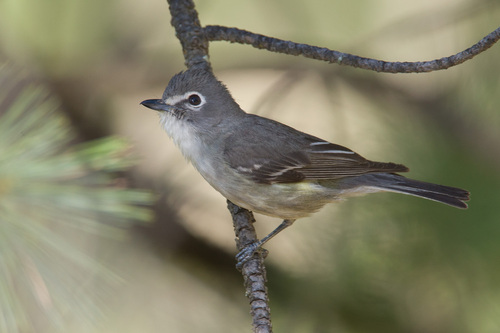
Plumbeous Vireo
Vireo plumbeus
A quiet master of the Western woodlands, the Plumbeous Vireo is defined by its smoky gray plumage and striking white 'spectacles.' Persistent and methodical, this bird brings a calm, steady presence to the high-country canopy.
Quick Identification
Size
Length: 4.7-5.5 in (12-14 cm) | Wingspan: 8.7-9.4 in (22-24 cm) | Weight: 0.5-0.6 oz (13-18 g)
Colors
Uniform lead-gray upperparts, crisp white underparts, and distinct white 'spectacles' around the eyes. Male and female look identical.
Key Features
- Bold white spectacles around the eyes
- Uniform lead-gray head and back
- Two distinct white wing bars
- Thick, slightly hooked bill
When You’ll See Them
Behavior
The Plumbeous Vireo is a patient and methodical hunter. Unlike warblers that flit frantically from branch to branch, this vireo moves at a much more deliberate pace, often staying within the mid-canopy for long periods as it searches for insects hidden on the undersides of leaves. Its song is a persistent series of husky, questioning whistles, often heard even during the hottest parts of the day when other birds have gone silent.
While they are not overly shy around humans, they are master camouflagers. They spend most of their time in the foliage, making them difficult to spot without the help of a camera or binoculars. In a backyard setting, they are most likely to be seen during migration or if your property features the pine-oak or pinyon-juniper woodlands they call home. They are solitary during the breeding season but may join mixed-species flocks during the winter months in the southern parts of their range.
EverydayEarth exclusive
Camera Tips
To capture the Plumbeous Vireo on camera, your best bet is to focus on water. Since these birds are primarily canopy-dwellers and do not visit traditional seed feeders, a birdbath—especially one with a dripper or moving water—is an irresistible lure. Place your camera at eye level with the water source, roughly 3 to 5 feet away, to capture the intricate details of their 'spectacles' and lead-gray plumage while they bathe.
Because they are small and move through dense foliage, use a camera with a fast trigger speed (under 0.5 seconds). If your AI-powered camera allows for custom detection zones, highlight the branches leading toward your water feature. This species often 'perch-hunts' nearby before committing to a landing, so catching them on an approach branch can result in stunning, clear shots of their profile.
For those living in hilly or mountainous regions, consider mounting a camera 6 to 10 feet high in a pinyon or juniper tree. Use a wide-angle lens setting if available, as these birds move methodically along branches. High-resolution video (1080p or 4K) at 30 or 60 fps is ideal for capturing their characteristic slow-motion foraging behavior, which differentiates them from the more erratic movements of flycatchers or warblers.
Early morning is the peak window for activity, so ensure your camera is positioned to avoid direct lens flare from the rising sun. A north-facing orientation is generally best for consistent lighting. During the nesting season (May-July), look for them to stay within a small territory; if you see one on camera, it is likely living nearby, and consistent monitoring of that spot will yield daily results.
Similar Species
Species that look similar or are commonly confused with Plumbeous Vireo.
Cassin's Vireo
Look for a greenish tint on the back and yellow flanks; the Plumbeous is strictly gray and white.
Blue-headed Vireo
Displays a much more contrasting blue-gray head and bright olive back compared to the uniform gray of the Plumbeous.
Gray Flycatcher
Lacks the white eye 'spectacles' and has a habit of dipping its tail downward, which vireos rarely do.
Frequently Asked Questions
Record Plumbeous Vireo at your habitat
Connect a camera to start building your own species record — AI identifies every visitor automatically.