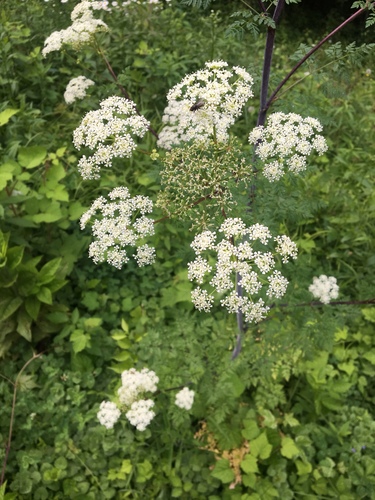
poison hemlock
Conium maculatum
A towering biennial with delicate lace-like flowers, poison hemlock hides a deadly toxicity beneath its elegant exterior. Master the art of identifying this invasive giant from a safe distance using your backyard trail camera.
Quick Identification
Size
Stands 1.5 to 3 meters (5 to 10 feet) tall; first-year rosettes are low to the ground, while second-year stalks are towering and hollow.
Colors
Smooth green stems mottled with distinct reddish-purple spots; delicate, fern-like bright green foliage; clusters of tiny white flowers.
Key Features
- Smooth, hairless stems with purple spots or blotches
- Finely divided, fern-like lacy leaves
- Small, white flowers in umbrella-shaped clusters (umbels)
- Large, hollow stalks that reach up to 10 feet tall
When You’ll See Them
Behavior
Poison hemlock is a biennial plant, meaning it completes its life cycle over two years. In its first year, it remains low to the ground as a rosette of lacy leaves, often mistaken for parsley or carrot greens. During its second year, it undergoes a dramatic "bolting" phase, where it sends up a tall, hollow flower stalk that can reach heights of ten feet. It is highly aggressive and often outcompetes native vegetation by emerging earlier in the spring and occupying nitrogen-rich soils.
The plant's most notable characteristic is its chemical defense system. It produces a variety of toxic alkaloids, primarily coniine, in every part of its structure—from the roots to the seeds. These toxins serve to deter herbivores, making it dangerous to livestock, pets, and humans. Because it reproduces solely by seed, a single plant can produce tens of thousands of seeds, allowing it to spread rapidly across disturbed landscapes and waterways.
EverydayEarth exclusive
Camera Tips
To capture the details of poison hemlock without putting yourself at risk, use a camera with a strong optical zoom or a high-resolution sensor that allows for digital cropping. Position your camera about 5 to 10 feet away from the specimen. The most important identification feature is the smooth, hairless stem with reddish-purple splotches. Aim your lens at the lower third of the main stalk to capture these markings clearly. If your camera has a macro mode, use it to get high-definition shots of the tiny, five-petaled white flowers arranged in umbrella-like clusters called umbels.
Because poison hemlock undergoes a massive growth spurt in its second year, this species is a perfect candidate for a time-lapse project. Set your trail camera to take one photo every 6 to 12 hours starting in late April. You will be able to watch the "bolt" as the plant transitions from a ground-level rosette into a towering giant in just a few weeks. Ensure the camera is mounted on a sturdy stake or post, as the plant can grow taller than most fences, and you may need to adjust the tilt of the camera upward as the season progresses.
Lighting is crucial for photographing white-flowered plants like hemlock. Mid-day sun can "blow out" the highlights, making the flowers look like a blurry white blob. For the best results, check your camera's footage from the early morning or late afternoon (the golden hour). The soft, angled light will reveal the intricate, skeletal structure of the flower heads and the fine, fern-like texture of the leaves. If your backyard camera has an adjustable exposure setting, try dropping it by one notch (-0.3 or -0.7 EV) to preserve the detail in the white blossoms.
While the plant itself is the focus, your camera might also catch interesting ecological interactions. Look for the Poison Hemlock Moth (Agonopterix alstroemeriana), whose larvae feed specifically on this plant. Setting your camera to a high-sensitivity motion trigger or "hybrid mode" (photo plus video) can help you document these small visitors. Just remember to never handle the plant while setting up your equipment—wear gloves if you are working near it, and wash your hands and gear thoroughly afterward to ensure no toxic sap remains on your camera housing.
Similar Species
Species that look similar or are commonly confused with poison hemlock.
Frequently Asked Questions
Record poison hemlock at your habitat
Connect a camera to start building your own species record — AI identifies every visitor automatically.