pondcypress
Taxodium ascendens
A majestic sentry of the Southeast, the pondcypress transforms from a feathery green spire in summer to a glowing copper monument in the fall.
Quick Identification
Size
Height: 50–70 ft (15–21 m); Spread: 15–25 ft (4.5–7.5 m); Trunk diameter: 1–3 ft (0.3–0.9 m)
Colors
Bright green summer foliage; copper, russet, or orange-brown autumn needles; gray-to-reddish-brown fibrous bark.
Key Features
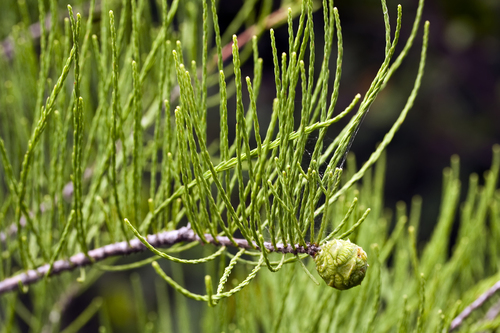
- Awl-like leaves that press upward against the twig
- Narrow, columnar or pyramidal growth habit
- Fibrous, shredding bark in vertical strips
- Rounded woody cones about 1 inch in diameter
- Presence of 'knees' or woody root projections in wet soil
When You’ll See Them
Behavior
The pondcypress is a remarkable deciduous conifer, meaning that unlike most evergreens, it sheds its needle-like leaves every autumn. In the wild, these trees are the architects of 'cypress domes,' where they grow in circular clusters with the tallest trees in the center of a depression, creating a distinctive mounded silhouette against the horizon. They are incredibly long-lived, with some specimens surviving for several centuries.
While they are slow growers, they are extremely hardy once established. They have a unique relationship with water; while they thrive in wet, acidic soils, they do not require standing water to survive in a backyard setting. Interestingly, pondcypress are much more tolerant of poor drainage and low-oxygen soil than most other landscape trees, making them a 'problem-solver' species for soggy areas of a property.
EverydayEarth exclusive
Camera Tips
When setting up an AI-powered camera to capture a pondcypress, focus on the seasonal transformation. This tree provides a dramatic 'slow-motion' show. Position your camera on a fixed post or a neighboring sturdy tree at a distance of 15–20 feet to capture the entire silhouette. Using a time-lapse setting is the best way to document the transition from the feathery lime-green of spring to the deep copper-orange of late autumn. These colors are most vibrant during the 'golden hour'—the hour after sunrise or before sunset—so ensure your camera is positioned to catch side-lighting rather than being pointed directly into the sun.
If your pondcypress is growing in or near water, place your camera at a low angle, roughly 2 feet off the ground or water level. This allows you to capture the 'knees' (pneumatophores) and the tree's reflection, which can create stunning, symmetrical compositions. If you are using an AI camera to detect wildlife, the pondcypress is a magnet for wood ducks, herons, and various songbirds. Aim your lens at the lower branches or the water's edge where these animals are likely to perch or forage.
Be mindful of the wind when setting your motion sensitivity. The fine, lace-like foliage of the pondcypress moves easily in a breeze, which can lead to hundreds of 'false' triggers if your camera's sensitivity is set too high. Use 'Zone Detection' features to ignore the upper swaying branches and focus the trigger area on the trunk or the ground/water beneath the tree where animals are more likely to move. In the winter, don't move the camera; the stark, craggy skeleton of the tree against a gray sky or snow provides a beautiful architectural element to your backyard feed.
Similar Species
Species that look similar or are commonly confused with pondcypress.
Frequently Asked Questions
Record pondcypress at your habitat
Connect a camera to start building your own species record — AI identifies every visitor automatically.