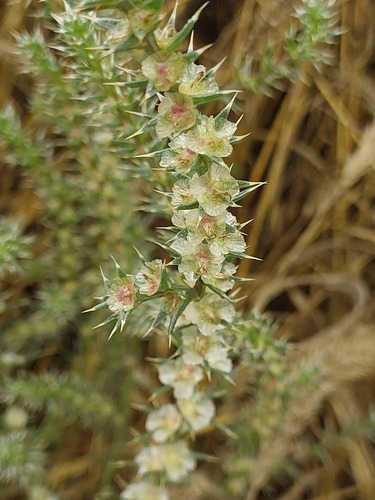
Prickly Russian Thistle
Salsola tragus
The legendary 'tumbleweed' of the American West, the Prickly Russian Thistle is a fascinating survivor that uses the wind to colonize the landscape. From its striped green youth to its iconic rolling finale, it is a master of desert dispersal.
Quick Identification
Size
Grows 30 to 100 cm (12 to 40 inches) tall and can reach a diameter of nearly 1 meter (3.3 feet) at maturity.
Colors
Juvenile plants are bright green with distinct red or purple longitudinal stripes on the stems; mature plants are straw-colored, tan, or grayish-brown.
Key Features
- Sharp, needle-like bracts (modified leaves)
- Rounded, bushy 'skeleton' shape
- Reddish stripes on succulent young stems
- Detaches at the root base when dry to roll with the wind
When You’ll See Them
Behavior
The Prickly Russian Thistle is the quintessential icon of the American West, though it is actually an invasive species from Eurasia. Its life cycle is a masterclass in seed dispersal. Starting as a soft, unassuming sprout, it quickly toughens into a prickly, spherical bush. Once the plant reaches maturity and the seeds are ripe, the entire structure dries out and becomes incredibly brittle.
The plant’s most famous trait is its 'autotomy'—it develops a specialized layer of cells at the base of the stem that allows it to snap off cleanly during high winds. As the dead plant body, or 'tumbleweed,' rolls across open terrain, it acts as a mechanical seed spreader, dropping up to 250,000 seeds over several miles. This behavior allows it to colonize disturbed soils rapidly, often outcompeting native vegetation and creating significant fire hazards when they pile up against buildings.
EverydayEarth exclusive
Camera Tips
Capturing the Prickly Russian Thistle on a backyard or trail camera is less about patience and more about strategic positioning. Since these 'wind witches' move with the breeze, the best way to get a great shot is to place your camera near natural bottlenecks or 'catchment' areas. Look for chain-link fences, corner alcoves of outbuildings, or dense shrub lines where tumbleweeds tend to pile up during a windstorm. Setting your camera to a high-sensitivity motion trigger or using a time-lapse mode during a particularly windy day will yield the most dynamic results.
To get a dramatic, professional-looking shot, aim for backlighting. Position your camera facing toward the setting or rising sun, but slightly off-axis to avoid direct lens flare. The low-angle light will catch the intricate, skeletal lattice of the dried thistle, making it 'glow' and stand out against the background. If you are filming video, use the highest frame rate available; seeing a tumbleweed bounce in slow motion reveals the surprising physics of its movement as it clears obstacles.
In terms of settings, a fast shutter speed (at least 1/500s) is essential if you want to freeze the tumbleweed mid-air during a bounce. If your camera allows for zone-based motion detection, focus the trigger area on the lower third of the frame where the plant is most likely to enter. Remember that these plants are most active as 'movers' in the late autumn and winter months, typically after the first hard frost has killed the main plant and the seasonal winds begin to pick up. For a unique perspective, place a camera low to the ground pointing upward to make a passing tumbleweed look like a giant rolling boulder.
Similar Species
Species that look similar or are commonly confused with Prickly Russian Thistle.
Frequently Asked Questions
Record Prickly Russian Thistle at your habitat
Connect a camera to start building your own species record — AI identifies every visitor automatically.