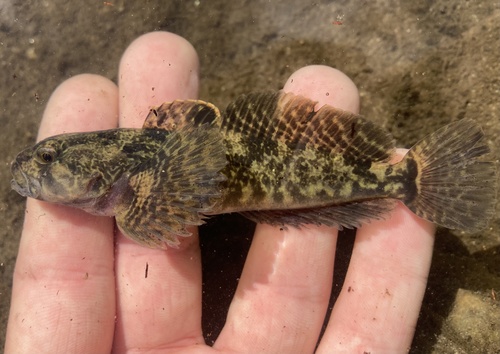
Prickly Sculpin
Cottus asper
The Prickly Sculpin is a master of disguise, lurking on the rocky bottoms of Pacific Northwest waterways. With its 'prickly' skin and ambush-predator lifestyle, this fascinating fish is a hidden gem of the backyard stream.
Quick Identification
Size
Typically 7.5 to 15 cm (3 to 6 inches) in length, though some individuals can reach up to 30 cm (12 inches).
Colors
Mottled olive-brown, gray, or dark green with irregular dark blotches and spots; the underside is usually cream or white.
Key Features
- Broad, flattened head with a wide mouth
- Large, fan-like pectoral fins used for 'walking' on the bottom
- Rough, prickly skin along the sides of the body
- Two dorsal fins that are nearly continuous
When You’ll See Them
Geographic range
Where Does the Prickly Sculpin Live?
Native to the Pacific Slope of North America, the Prickly Sculpin enjoys a massive range that extends from the cold waters of Seward, Alaska, southward through British Columbia and the Pacific Northwest into the Ventura River of Southern California. While primarily a coastal drainage resident, it has crossed the Continental Divide into the Peace River system and has been introduced into several man-made reservoirs within Southern California.
Basemap © OpenStreetMap contributors
Behavior
The Prickly Sculpin is a master of camouflage and a patient hunter. As a benthic fish, it spends the majority of its life resting directly on the bottom of stream beds or lake floors. It is primarily nocturnal, remaining tucked away under rocks, logs, or within thick aquatic vegetation during daylight hours to avoid predators like herons and larger fish. When night falls, it becomes more active, moving across the substrate in short, darting bursts.
These fish are known for their 'sit-and-wait' predatory style. They remain perfectly still, blending in with the gravel or silt until a prey item wanders too close. With a sudden, lightning-fast expansion of their large mouths, they create a vacuum that pulls the prey inside. While generally solitary, they may congregate in high-quality feeding areas or during the spring spawning season, where males defend nesting sites under flat rocks.
EverydayEarth exclusive
Camera Tips
Capturing the Prickly Sculpin on camera requires a specialized approach, as these fish are strictly underwater dwellers. Use a waterproof action camera or a dedicated underwater trail camera. For the best results, place the camera in shallow water—between 6 and 18 inches deep—where sculpins are most active at night. Position the lens at a low angle, almost resting on the substrate, to capture their unique profile and 'walking' behavior with their pectoral fins.
Focus your efforts on 'structure' such as large, flat rocks or submerged logs. Prickly Sculpins use these as anchors for their territory. If you can find a cluster of cobble-sized stones in a slow-moving part of a creek, you are likely looking at a sculpin neighborhood. Because they are mottled and blend in perfectly with the bottom, look for the movement of their gills or the occasional darting motion to confirm their presence before setting your permanent camera spot.
Since these fish are most active under the cover of darkness, your camera must have excellent low-light performance or infrared (IR) capabilities. Standard white light LEDs may startle the fish or cause unwanted reflections off floating sediment, so 'no-glow' IR is often the best choice for natural behavior. Set your camera to record short video clips (15-30 seconds) rather than still photos, as the way these fish move is one of their most identifying and interesting characteristics.
To attract a sculpin into the frame, you can use scent rather than visual bait. A small mesh bag filled with crushed salmon pellets or canned tuna (in water) secured near the camera's focal point can draw them out from their hiding spots. Be sure to check your local fishing and wildlife regulations regarding 'chumming' or baiting before doing this. Ensure your camera is heavily weighted or tethered to a fixed object on the bank to prevent it from being lost during high water or moved by curious larger animals like raccoons.
Similar Species
Species that look similar or are commonly confused with Prickly Sculpin.
Frequently Asked Questions
Record Prickly Sculpin at your habitat
Connect a camera to start building your own species record — AI identifies every visitor automatically.