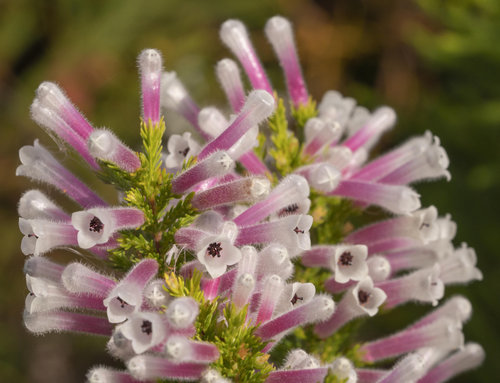
Prince of Wales Heath
Erica perspicua
A botanical masterpiece of the Western Cape, the Prince of Wales Heath stands out with its striking pink-and-white tubular plumes. It is more than just a beautiful shrub; it is a vital fueling station for South Africa's most colorful sunbirds.
Quick Identification
Size
A slender, upright shrub typically reaching 1 to 2 metres (3.3 to 6.6 feet) in height.
Colors
Distinctive bi-colored tubular flowers that are usually bright pink or reddish at the base with pure white tips.
Key Features
- Long, tubular flowers roughly 25-30mm in length
- Erect, slender branches with a feathery, needle-like leaf structure
- Bi-colored pink and white blooms clustered at branch ends
- Stems and leaves covered in soft, fine hairs (pubescence)
When You’ll See Them
Geographic range
Where Does the Prince of Wales Heath Live?
This elegant species is native to the African continent and is found exclusively within the Western Cape province of South Africa. It is a prime example of fynbos endemism, with a core range that extends from the Cape Peninsula through the Hottentots Holland Mountains to the Kogelberg and Houhoek regions. It is rarely found far from the specialized Mediterranean climate and acidic soils of the Cape Floristic Region.
Basemap © OpenStreetMap contributors
Behavior
The Prince of Wales Heath is a perennial shrub that plays a central role in the fynbos ecosystem of South Africa. Unlike many ericas that rely on wind or insects, this species is a specialist in bird pollination. Its sturdy, tubular flowers are designed to accommodate the curved beaks of sunbirds. As these birds probe for nectar, the plant deposits pollen on their foreheads, ensuring genetic diversity as the birds move from shrub to shrub.
In its natural environment, this plant is highly adapted to fire-prone cycles. While the individual shrub may be consumed by fire, it is a 're-seeder,' meaning it relies on a massive bank of tiny seeds stored in the soil to regenerate. These seeds are often triggered to germinate by the chemical signals in smoke and the heat of a passing fire, leading to a synchronized bloom of new plants in the following seasons.
EverydayEarth exclusive
Camera Tips
When setting up a camera for the Prince of Wales Heath, your goal isn't just to see the plant, but to capture the vibrant birdlife it attracts. Place your camera on a sturdy stake or tripod approximately 1 to 1.5 metres (3 to 5 feet) away from the most active flower clusters. For the best AI identification results, frame the shot so the pink-and-white tubular flowers are centered against a neutral background like a clear sky or distant green foliage.
Because this species is a magnet for the Orange-breasted Sunbird and the Cape Sugarbird, high-speed settings are essential. Set your trail camera to 'Burst Mode' with a minimum of 3-5 photos per trigger. These birds move with incredible speed, and a standard single-shot setting will often result in a blurred tail or an empty frame. If your camera allows for manual shutter speed, aim for 1/1000th of a second or faster to freeze the wing motion of visiting pollinators.
Placement is critical in the windy fynbos environment. To avoid thousands of false triggers caused by the slender branches swaying in the breeze, lower the motion sensitivity of your camera or use 'Zone Triggering' to focus only on the area immediately surrounding the flowers. If the plant is in a particularly windy spot, you might consider using a small garden stake to gently stabilize the specific branch you are filming, taking care not to damage the delicate bark.
For a unique perspective, try a long-term time-lapse. Set your camera to take one photo every 4 to 6 hours over the course of several weeks during the summer. This will capture the spectacular progression of the 'Prince of Wales' plumes as they transition from small green buds into full, bi-colored bloom. Since this plant thrives in damp seeps, always ensure your camera housing is fully waterproofed to protect against the heavy mountain mists common in its habitat.
Frequently Asked Questions
Record Prince of Wales Heath at your habitat
Connect a camera to start building your own species record — AI identifies every visitor automatically.