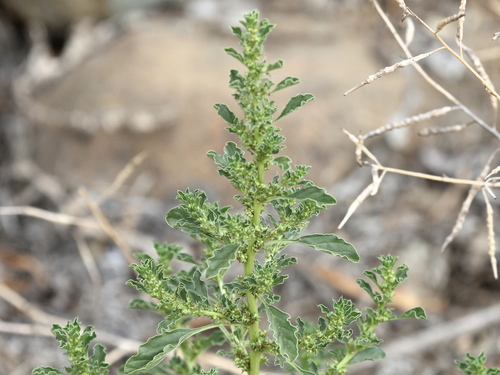
prostrate pigweed
Amaranthus albus
The ultimate survivor of the backyard, Prostrate Pigweed transforms from a low-profile ground cover into the iconic rolling tumbleweed of the American landscape.
Quick Identification
Size
Typically 10-50 cm (4-20 inches) in height; can spread up to 1 meter (3.3 feet) wide as a tumbleweed
Colors
Pale green to whitish stems; yellowish-green flower clusters; dark green to dull green leaves
Key Features
- Prostrate or bushy growth habit
- Whitish, highly branched stems
- Flowers occur in small clusters at leaf axils, not terminal spikes
- Leaves are small, spatulate or oval with slightly wavy margins
When You’ll See Them
Behavior
Prostrate pigweed, often known as the common tumbleweed, is a master of opportunistic growth. It is a pioneer species, meaning it is often the first to colonize bare or disturbed soil. While it starts its life hugging the ground or forming a compact bush, its most famous behavior occurs at the end of its life cycle. Once the plant matures and produces its seeds, the stem breaks off at the base, and the entire dried structure begins to roll with the wind.
This 'tumbling' is a highly effective seed dispersal strategy, allowing a single plant to scatter thousands of seeds across a wide area. In the garden or backyard, it is often viewed as a persistent weed due to its high drought tolerance and rapid growth. Despite its reputation, it plays a role in the local ecosystem by stabilizing soil and providing a micro-habitat for small ground-dwelling insects during its green phase.
EverydayEarth exclusive
Camera Tips
Capturing the life of a prostrate pigweed on a backyard camera requires a focus on time-lapse and macro photography. Because this plant is stationary for most of its life, set your camera to a time-lapse mode—one frame every hour during daylight—to document its rapid expansion from a tiny sprout to a complex, branched skeleton. Position your camera on a low tripod or a 'ground pod' just a few inches off the earth to get an intimate, wide-angle view of its sprawling architecture.
To capture the plant's unique 'tumbleweed' phase, wait for the first hard frost of autumn. This is when the plant dries out and becomes brittle. If you use a motion-activated camera, place it downwind of the plant during a breezy day. You might catch the dramatic moment the stem snaps and the plant begins its journey across your yard. High shutter speeds are essential here to freeze the movement of the rolling plant in the wind.
Don't overlook the visitors! Prostrate pigweed is a hub for biodiversity. Position a macro-capable camera near the leaf axils (where the leaves meet the stem) to capture the tiny pollinators and predatory insects that hunt within its branches. Because the stems are often whitish or very pale green, avoid harsh mid-day sun which can cause 'blown out' highlights; instead, aim for the golden hour (just before sunset) when the low light creates beautiful rim-lighting on the plant's intricate branch structure.
Frequently Asked Questions
Record prostrate pigweed at your habitat
Connect a camera to start building your own species record — AI identifies every visitor automatically.