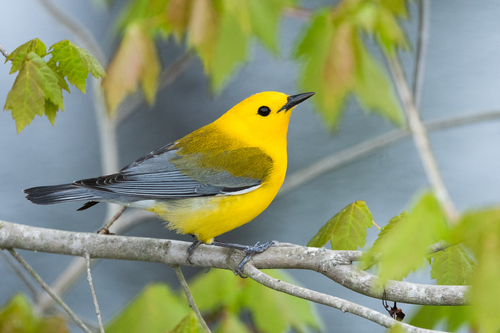
Prothonotary Warbler
Protonotaria citrea
Glowing like a candle in the swamp, the Prothonotary Warbler is a stunning golden treasure of the wetlands. One of the only warblers to nest in tree cavities, it brings a flash of tropical brilliance to the riverbanks of North America.
Quick Identification
Size
Length: 5.1 in (13 cm); Wingspan: 8.7 in (22 cm); Weight: 0.44–0.56 oz (12.5–15.8 g)
Colors
Brilliant golden-yellow head and underparts; blue-gray wings and tail; white undertail. Females are slightly duller with a greenish wash on the crown.
Key Features
- Vibrant golden-yellow head and breast
- Blue-gray wings without wing bars
- Large, soulful black eyes
- Heavy, pointed black bill
When You’ll See Them
Behavior
The Prothonotary Warbler is often referred to as the 'Swamp Candle' due to its luminous yellow plumage that seems to glow in the shaded understory of wooded wetlands. Unlike many other warblers that prefer the high canopy, this species stays relatively low, often flitting just a few feet above the water. They are agile foragers, frequently hopping along fallen logs and scanning the undersides of leaves for insects.
During the breeding season, males are highly territorial and vocal, delivering a loud, ringing series of notes to claim their patch of swamp. They are remarkably unique among eastern warblers for being secondary cavity nesters, meaning they don't build nests on branches but rather inside holes in trees. They are generally tolerant of humans if their habitat is respected, and they are one of the few warbler species that will readily accept a man-made nest box if placed in an ideal location.
EverydayEarth exclusive
Camera Tips
To capture high-quality footage of a Prothonotary Warbler, location is everything. Because they are cavity nesters, your best bet is to mount an AI-powered camera near a suitable nest box. These boxes should be placed over or within 20 feet of standing water, roughly 4 to 6 feet high. Position the camera at a 45-degree angle to the entrance hole rather than directly in front of it; this ensures you capture the bird's profile and the brilliant blue-gray of their wings as they land, rather than just the back of their head.
If you don't have a nest box, focus on water. Prothonotary Warblers are fastidious bathers. A shallow birdbath or a 'bubbler' placed in a shaded, quiet corner of a yard near a creek can be a magnet. Set your camera low to the ground to match their eye level. Since they live in high-contrast environments—bright yellow feathers against dark swamp shadows—manually adjust your exposure if possible to avoid blowing out the yellow highlights. A fast trigger speed is essential, as their visits to the water are often quick and erratic.
During the peak of spring migration (late April to May), consider using a 'mealworm feeder' near a water source to lure them into the camera's frame. While they are primarily wild foragers, the movement of live mealworms can catch their eye. For the best lighting, aim for the 'golden hour' shortly after sunrise. The low-angled light filtering through the trees will make their yellow plumage look spectacular without the harsh shadows of midday sun. Keep your camera firmware updated to ensure its AI can distinguish this specific bright yellow bird from more common species like American Goldfinches.
Similar Species
Species that look similar or are commonly confused with Prothonotary Warbler.
Frequently Asked Questions
Record Prothonotary Warbler at your habitat
Connect a camera to start building your own species record — AI identifies every visitor automatically.