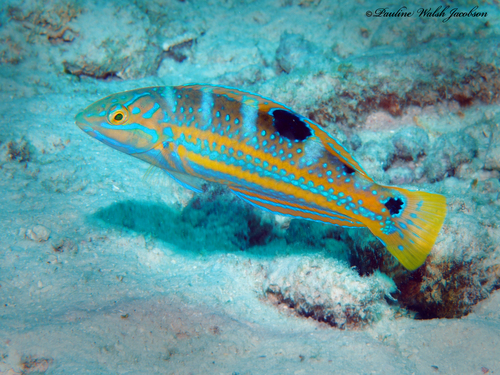
Puddingwife Wrasse
Halichoeres radiatus
With its shimmering iridescent scales and bold personality, the Puddingwife Wrasse is the jewel of the Atlantic reefs. This active carnivore is a master of the coral landscape, darting through crevices with a flash of brilliant blue-green.
Quick Identification
Size
Typically 30-40 cm (12-16 in), reaching a maximum length of 51 cm (20 in)
Colors
Adults are brilliant blue-green with yellow highlights and blue-rimmed scales; juveniles are yellow to orange with two white horizontal stripes and black dorsal spots.
Key Features
- Brilliant blue-green adult coloration with iridescent scales
- Elongated, cigar-shaped body with a blunt snout
- Large, fleshy lips and prominent canine teeth for crushing shells
- Distinctive 'saddle' markings or white spots on the back in subadults
When You’ll See Them
Geographic range
Where Does the Puddingwife Wrasse Live?
The Puddingwife Wrasse is a quintessential resident of the warm Western Atlantic tropical waters. Its territory begins as far north as North Carolina and extends through the crystal-clear waters of Bermuda and the Bahamas, stretching across the entire Gulf of Mexico and throughout the Caribbean Sea. Interestingly, while they are found as far south as the offshore islands of Brazil, they are notably absent from the mainland Brazilian coastline, preferring the offshore reef systems and island chains of the West Indies.
Basemap © OpenStreetMap contributors
Behavior
The Puddingwife Wrasse is a highly active and inquisitive reef dweller that spends its daylight hours constantly on the move. They are known for their 'bouncing' swimming style, powered primarily by their pectoral fins. As protogynous hermaphrodites, these fish begin their lives as females and can transition into colorful terminal-phase males as they grow and social hierarchies shift. This transition is marked by a dramatic change in both color and size.
These wrasses are solitary hunters but are often observed following larger bottom-feeding species like goatfish or stingrays. They act as opportunists, snatching up small invertebrates that are stirred up from the sand by the larger animals. While they are generally wary of humans, they can become quite bold around underwater cameras once they realize the device isn't a threat. At night, they exhibit a unique survival strategy by burrowing into the sandy seabed to sleep, safely hidden from nocturnal predators.
EverydayEarth exclusive
Camera Tips
Capturing a Puddingwife Wrasse on camera requires a focus on depth and lighting. Because these fish are most vibrant in shallow water, aim to place your underwater camera in reef flats or near rocky outcrops between 2 and 5 meters deep. At this depth, the red spectrum of sunlight hasn't been completely filtered out, which helps the camera capture the stunning iridescent blues and greens of the adult Puddingwife. Using a red filter on your lens or adjusting your white balance for underwater settings is highly recommended to prevent the footage from looking overly blue.
Puddingwife Wrasses are naturally curious and are often attracted to the 'newness' of a camera in their territory. To encourage a close-up, place your camera near a patch of sandy bottom adjacent to a reef. You can gently disturb the sand or flip a small rock (if local regulations permit) to expose tiny invertebrates; the wrasse will likely dart in to investigate the potential meal. If you are using a stationary trail-style underwater camera, a small mesh bag filled with crushed clam or urchin shells can serve as an effective lure to keep them in the frame for longer durations.
For the best results, use a high frame rate setting (at least 60fps). These fish move with quick, jerky motions and a standard frame rate may result in motion blur. Position the camera at a slight upward angle toward the water's surface to take advantage of natural backlighting, which makes their scales shimmer. Be patient—it often takes 15-20 minutes for the fish to accept the camera as part of the reef landscape, at which point they will resume their natural foraging behaviors right in front of the lens.
Similar Species
Species that look similar or are commonly confused with Puddingwife Wrasse.
Frequently Asked Questions
Record Puddingwife Wrasse at your habitat
Connect a camera to start building your own species record — AI identifies every visitor automatically.