Puna Teal
Spatula puna
With its striking black cap and sky-blue bill, the Puna Teal is an elegant icon of the high Andes. Discover how to identify and capture this mountain specialist in its stunning wetland habitat.
Quick Identification
Size
Length: 43–51 cm (17–20 in); Weight: 500–600 g (1.1–1.3 lbs)
Colors
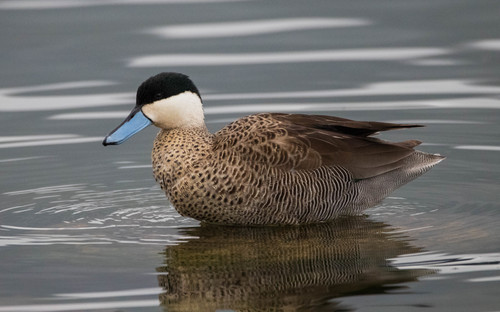
Distinctive black cap, creamy-white face, and a pale blue bill with a black central line; body is buff-brown with dark spotting
Key Features
- Deep black cap extending below the eyes
- Large, pale blue bill with a thin black line down the culmen
- Creamy-white cheeks and throat
- Buff-colored flanks with delicate dark scalloping
When You’ll See Them
Behavior
Puna Teals are social and generally docile dabbling ducks, often seen in pairs or small family groups. Unlike many other duck species that undergo long-distance migrations, these birds are relatively sedentary, remaining in their high-altitude Andean homes year-round. They spend a significant portion of their day 'tipping up' in shallow water, a classic dabbling behavior used to reach underwater plants and seeds.
While they are not overly shy, they maintain a cautious distance from humans, especially in areas where they aren't habituated to presence. They are relatively quiet compared to northern mallards, though they do communicate with soft, melodic whistles and low-pitched quacks. During the breeding season, they become more territorial and are frequently seen guarding specific sections of shoreline or marshy patches.
EverydayEarth exclusive
Camera Tips
Capturing the Puna Teal on camera requires focusing on the water's edge. Because they are dabblers, they spend most of their time in the shallows rather than the deep center of a lake. Position your camera on a low-profile stake or a weighted base just a few inches above the water level. This 'duck's-eye view' provides a much more intimate and professional look than shooting from a high bank. If your camera has a wide-angle lens, aim it to include the dramatic Andean peaks in the background, which adds incredible context to the shot.
Lighting is your biggest challenge at high altitudes where the sun is exceptionally bright. To avoid 'blowing out' the white cheeks and highlights on the blue bill, set your camera to underexpose slightly if the software allows. The best footage is almost always captured during the first two hours of daylight or the last hour before sunset. During these times, the golden light reflects off the water and highlights the intricate scalloped patterns on the duck's feathers, which can look flat and brown in midday sun.
Look for 'loafing spots'—flat rocks, mudflats, or grassy hummocks where the ducks climb out of the water to preen and rest. These areas are goldmines for trail cameras. You can identify these spots by looking for flattened grass, droppings, or stray feathers. Since these ducks move their heads rapidly while feeding, a fast trigger speed is essential to avoid motion blur. If you are using a video-capable camera, 60fps (frames per second) is ideal for capturing the fluid motion of their dabbling and the way they shake water off their plumage.
Similar Species
Species that look similar or are commonly confused with Puna Teal.
Frequently Asked Questions
Record Puna Teal at your habitat
Connect a camera to start building your own species record — AI identifies every visitor automatically.