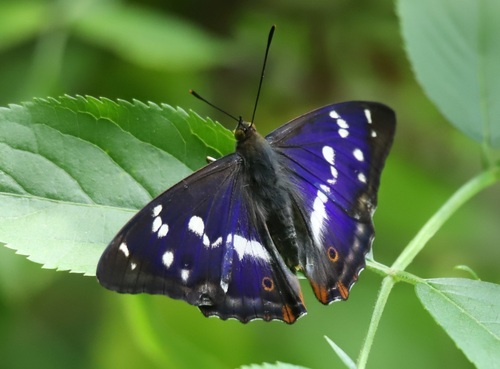
Purple Emperor
Apatura iris
Known as the 'Emperor of the Woods,' this magnificent butterfly is famous for its elusive canopy-dwelling lifestyle and the breathtaking purple iridescence of the males.
Quick Identification
Size
Wingspan of 70–92 mm (2.75–3.6 inches)
Colors
Males feature a brilliant iridescent violet-blue sheen over dark brown; females are slightly larger and dark brown without the purple sheen. Both have white bands and an orange-ringed eyespot on the hindwing.
Key Features
- Brilliant iridescent purple sheen on male wings
- Broad white 'V' or 'L' shaped bands across mid-wings
- Orange-ringed eyespot on the hindwing
- Large, powerful gliding flight profile
When You’ll See Them
Geographic range
Where Does the Purple Emperor Live?
Where Does the Purple Emperor Live? This regal butterfly is native to the Palearctic region, stretching across a broad latitudinal band from Western Europe to Central Asia and into Japan. Within Europe, it is most frequently found in the southern half of England, France, Germany, and across Central and Eastern Europe. While it is a resident species, its distribution is often localized to specific ancient woodland sites where its host plants and 'master trees' are abundant.
Basemap © OpenStreetMap contributors
Behavior
The Purple Emperor is an elusive and majestic butterfly, often referred to by enthusiasts as 'His Imperial Majesty.' Unlike most butterflies that spend their time visiting flowers for nectar, this species is arboreal, living most of its life high in the canopy of mature broadleaf woodlands. Males are highly territorial and are known to defend 'master trees'—typically the tallest oaks on a hill—where they engage in high-speed aerial dogfights with rival males.
Because they do not frequent flowers, they are rarely seen at eye level except when they descend to the forest floor to seek out moisture and minerals. They are famously attracted to unsavory substances such as animal droppings, carrion, and even human sweat, which provide the essential salts they need for breeding. Their flight is powerful and bird-like, alternating between rapid wingbeats and long, graceful glides.
EverydayEarth exclusive
Camera Tips
Capturing the Purple Emperor on a trail camera requires a bit of 'scent engineering' since they rarely visit flowers. To bring them down from the canopy, you should use a pungent attractant. Traditional butterfly baits like fermenting fruit work well, but for this species, experts recommend using highly odorous substances like shrimp paste, fish sauce, or even very ripe, smelly cheese placed on a flat stone in a sunny forest clearing.
Set your camera on a low tripod or mount it to a stake about 1 to 2 feet off the ground, facing your bait station. Ensure the station is in a spot that receives direct sunlight between 11 AM and 2 PM, as this is when males are most likely to descend to feed. A 'macro' setting or a camera with a close focal distance is ideal for capturing the intricate detail of their scales and the orange-ringed eyespots.
Since the purple iridescence of the male is structural—meaning it only appears when light hits the wings at a specific angle—position your camera so the sun is behind it or to the side. This increases the chances of the 'purple flash' being captured as the butterfly shifts its position while feeding. Because the flight season is very short, usually peaking in early July, it is best to have your camera deployed and active for the full month to catch their brief window of activity.
Frequently Asked Questions
Record Purple Emperor at your habitat
Connect a camera to start building your own species record — AI identifies every visitor automatically.