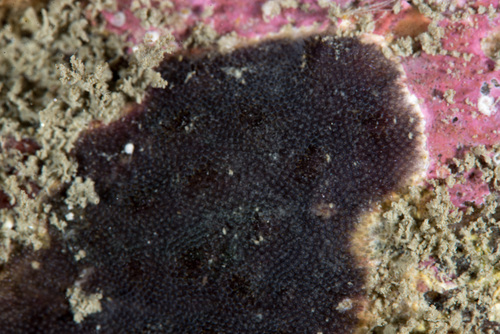
Purple Encrusting Bryozoan
Reptadeonella violacea
Transforming rocky shorelines into vibrant violet mosaics, the Purple Encrusting Bryozoan is a master of colonial architecture. These 'moss animals' create hard, stony crusts that provide a splash of royal color to the hidden world of tidepools and reefs.
Quick Identification
Size
Individual zooids are approximately 0.5 mm (0.02 in); colonies typically reach 2–10 cm (0.8–4 in) in diameter.
Colors
Deep violet, purple, or reddish-purple; often features a lighter white or pale lavender growing edge.
Key Features
- Vivid violet or purple coloration
- Hard, calcified crust-like growth
- Porous surface texture composed of microscopic zooecia
- Flat, spreading colonial structure
When You’ll See Them
Geographic range
Where Does the Purple Encrusting Bryozoan Live?
This striking marine invertebrate is primarily native to the temperate and subtropical waters of the Northeast Atlantic Ocean and the Mediterranean Sea. It is most commonly found along the rocky coastlines of the United Kingdom, Ireland, and France, extending southward to the Azores and the northern coast of Africa. In the Mediterranean, it thrives in sheltered reef environments and sea caves, where it adds a splash of royal color to the dark rocky seafloor.
Basemap © OpenStreetMap contributors
Behavior
The Purple Encrusting Bryozoan is a colonial organism made up of thousands of microscopic individuals known as zooids. Unlike the mobile wildlife most people are used to, this species is sessile, meaning it remains permanently attached to a hard surface. It expands its territory by budding new clones at the edges of the colony, creating a beautiful, spreading purple mat that can eventually cover entire rocks or shells.
As a suspension feeder, the colony acts as a collective filtration system. Each tiny zooid possesses a lophophore—a ring of ciliated tentacles that emerge to create microscopic water currents. These currents draw in oxygen and food particles, which are then shared across the colony through a network of connective tissue. Though they appear motionless to the naked eye, a colony is a hive of constant microscopic activity, especially when the tide is in.
EverydayEarth exclusive
Camera Tips
Capturing the Purple Encrusting Bryozoan on camera requires a specialized approach since they live underwater. If you have a 'backyard' tidepool or live near a rocky shore, you will need a waterproof action camera or a trail camera in a dedicated underwater housing. Because these colonies are stationary, traditional PIR motion sensors won't work; instead, use a time-lapse setting or manual video trigger to capture the colony in its natural state.
Placement is critical. Look for purple patches on the undersides of overhanging rocks or within deep crevices during a very low tide. Mount your camera using a weighted tripod or a clamp to ensure it doesn't move with the surge of the waves. Position the lens as close as possible—ideally within 10–20 centimeters—to capture the intricate details of the zooecia (the tiny 'rooms' the animals live in). Using a macro lens attachment will significantly improve the quality of your shots.
Lighting is your best friend when photographing this species. In the shadows of rocks or deep water, the purple pigment can look dark or even black. Use a high-quality underwater LED video light positioned at a 45-degree angle to the colony. This side-lighting creates shadows that highlight the 'pitted' texture of the bryozoan, making the colony look three-dimensional and vibrant. Avoid using a direct front flash, which can wash out the subtle violet hues.
For a unique perspective, set your camera to take a high-resolution photo every 30 seconds over a full tide cycle. When the water covers the colony, you might capture the lophophores—the tiny, flower-like feeding tentacles—emerging from their stony homes. This 'blooming' effect is rarely seen by casual observers and provides incredible footage of the colony’s collective behavior. Ensure the water is clear and calm, as suspended sand or silt will degrade the image quality.
Frequently Asked Questions
Record Purple Encrusting Bryozoan at your habitat
Connect a camera to start building your own species record — AI identifies every visitor automatically.