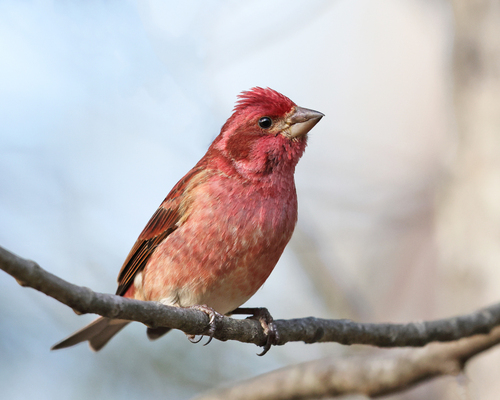
Purple Finch
Haemorhous purpureus
Often described as a sparrow dipped in raspberry juice, the Purple Finch is a vibrant addition to any backyard. This hardy songbird brings a splash of 'old world' color and a beautiful, bubbling song to North American forests and feeders alike.
Quick Identification
Size
Length: 4.7-6.3 in (12-16 cm); Wingspan: 8.7-10.2 in (22-26 cm); Weight: 0.6-1.1 oz (18-32 g)
Colors
Males are a rich raspberry-red (often described as 'dipped in cranberry juice') on the head, breast, and back. Females are heavily streaked with brown and white, featuring a bold white eyebrow stripe.
Key Features
- Raspberry-red plumage on males extending across the back
- Strong, notched tail
- Distinctive white 'eyebrow' and dark cheek patch on females
- Thick, conical seed-cracking beak
When You’ll See Them
Behavior
Purple Finches are energetic and social songbirds often found in small flocks, particularly outside the breeding season. They are famous for their loud, warbling songs and distinctive 'pick' call notes, which are often heard as they fly overhead. While they are forest-dwellers by nature, they are frequent visitors to backyard feeding stations, especially in winter when they may travel in nomadic groups searching for food.
In a backyard setting, they are often seen alongside House Finches, though they tend to be slightly more flighty and wary of human activity. They move with quick, bouncy flights and spend much of their time perched in the outer branches of trees or hopping around on elevated feeders. They are known for being somewhat dominant at the feeder, occasionally lunging at smaller birds to defend a prime seed spot.
EverydayEarth exclusive
Camera Tips
To capture the stunning raspberry hues of a male Purple Finch, camera positioning is everything. Place your camera at eye-level with a bird feeder, ideally 4 to 5 feet off the ground. These finches prefer platform feeders or large hopper feeders over tube feeders because they provide a stable place to land and crack open seeds. Orient your camera so it faces away from the sun (North or South) to avoid blowing out the vibrant reds of the male's plumage, which can easily look overexposed and 'pink' in direct midday light.
High-quality black oil sunflower seeds or sunflower hearts are the best lures for Purple Finches. If you have coniferous trees like pines or spruces nearby, try mounting a camera on a branch or a nearby fence post; they love to linger in these 'staging' areas before diving into a feeder. A shallow birdbath with a small dripper or heater (in winter) is another excellent set for your camera, as these birds are frequent drinkers and will often stay for several minutes to bathe, providing great video opportunities.
Timing and camera settings are crucial for crisp shots. Set your AI camera to trigger on 'Small Birds' with a short burst or high-frame-rate video setting (at least 60fps) to catch their quick movements and tail-flicks. Since they are most active in the early morning, ensure your camera's sensor can handle lower light without becoming too grainy. During 'irruption' years—when northern populations move south in massive numbers—you might see dozens at once; consider using a wider-angle lens setting to capture the social dynamics of the entire flock.
Similar Species
Species that look similar or are commonly confused with Purple Finch.
Frequently Asked Questions
Record Purple Finch at your habitat
Connect a camera to start building your own species record — AI identifies every visitor automatically.