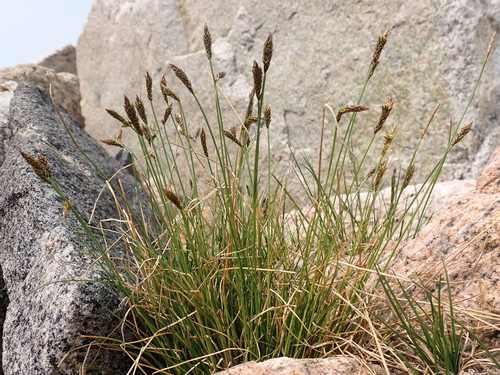
Pyrenean Sedge
Carex pyrenaica
A resilient specialist of the world's highest peaks, the Pyrenean Sedge thrives in the shadow of lingering snowbanks. This tiny, tufted perennial is a silent witness to the changing seasons of our most fragile alpine ecosystems.
Quick Identification
Size
Height: 5–20 cm (2–8 inches); leaves are narrow and thread-like, usually 1–1.5 mm wide.
Colors
Bright green to yellowish-green foliage; flowering spikes are dark brown to nearly black.
Key Features
- Dense, tufted (caespitose) growth habit without long rhizomes
- Solitary, terminal flower spike (androgynous)
- Narrow, channelled leaves that often curve slightly
- Thrives in alpine 'snowbed' habitats with late-lingering snow
When You’ll See Them
Geographic range
Where Does the Pyrenean Sedge Live?
The Pyrenean Sedge exhibits a remarkable disjunct distribution, appearing in high-altitude regions across the globe. Native to the Pyrenees mountains of Spain and France, it is also widely established across Western North America, ranging from Alaska and the Yukon down through the high peaks of the Rocky Mountains into Colorado and Utah. Additionally, isolated populations are found in Japan, Southeast Australia, and New Zealand, making it a true global citizen of the alpine world.
Basemap © OpenStreetMap contributors
Behavior
As a perennial sedge, the Pyrenean Sedge is a master of alpine survival. Unlike animals, its 'behavior' is defined by its growth cycle and resilience to extreme conditions. It spends the vast majority of the year dormant under several meters of snow. When the spring melt finally reaches its high-altitude home, the plant undergoes a rapid burst of activity, flowering and seeding within a very narrow window before the autumn frosts return.
This species is a quintessential 'snowbed' plant, meaning it is specifically adapted to areas where snow stays late into the summer. This specialized niche allows it to avoid competition from larger, more aggressive grasses that require a longer growing season. It plays a vital role in its ecosystem by stabilizing loose, rocky alpine soils and providing a micro-habitat for high-altitude insects and forage for small mammals like pikas.
EverydayEarth exclusive
Camera Tips
Capturing the life cycle of the Pyrenean Sedge requires a shift in strategy from traditional wildlife photography. Since plants do not trigger PIR (Passive Infrared) motion sensors, you must rely on your camera's 'Time Lapse' mode. Set your camera to take a photo every 2 to 4 hours during daylight. This will allow you to compile a sequence showing the plant emerging from the snow, flowering, and eventually turning golden-brown as it returns to dormancy.
Placement is critical for such a low-growing species. Mount your camera on a ground-level stake or a flexible mini-tripod, positioning the lens only 15-20 centimeters (6-8 inches) off the ground. A slight downward angle is best for capturing the dense, tufted texture of the leaves and the dark, solitary spikes. Ensure the area immediately in front of the lens is clear of loose debris or taller grasses that might obscure the sedge when the wind blows.
Because the Pyrenean Sedge lives in high-altitude, high-UV environments, light can be very harsh. The best photographic results often come from the diffused light of a slightly overcast day or the 'golden hour' shortly after sunrise. If your camera settings allow, use a macro focus or a narrow aperture to keep the delicate details of the flowering spike in sharp focus against the rocky background.
Finally, remember that alpine environments are extremely fragile and weather-dependent. Use a high-capacity SD card and ensure your battery setup (preferably with a solar panel if the site is sunny) can handle several weeks of operation, as the most interesting growth phases can be delayed by a late-season cold snap. Protect your camera with a weather-shield to prevent lens fogging, which is common in the damp, misty conditions of alpine snowbeds.
Frequently Asked Questions
Record Pyrenean Sedge at your habitat
Connect a camera to start building your own species record — AI identifies every visitor automatically.