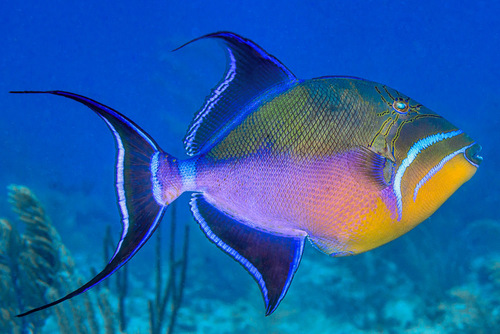
Queen Triggerfish
Balistes vetula
The Queen Triggerfish is a regal and clever architect of the Atlantic reefs, easily recognized by its vibrant blue 'war paint' and elegant fin streamers. A master of the sea floor, it uses ingenious tactics to hunt the ocean's most well-defended prey.
Quick Identification
Size
Typically 30–50 cm (12–20 in) in length, but can reach up to 60 cm (24 in); weight ranges from 1.5–5.4 kg (3.3–12 lbs).
Colors
Base color varies from olive-green to steel-grey; features two distinctive electric blue stripes on the face and blue rays radiating from the eyes; fins are trimmed in neon blue.
Key Features
- Two vivid blue 'bridle' stripes across the snout
- Greatly elongated tips on the dorsal and caudal fins
- Small mouth with powerful teeth for crushing shells
- Dorsal spine that can be 'triggered' and locked into place
When You’ll See Them
Geographic range
Where Does the Queen Triggerfish Live?
The Queen Triggerfish is a quintessential resident of the tropical Atlantic Ocean. Its native range extends from the coastal waters of North Carolina and the Gulf of Mexico, down through the entire Caribbean Sea to the shores of Brazil. It is also found in the eastern Atlantic, specifically around the Azores, Cape Verde, and along the western coast of Africa, thriving in warm, clear waters where coral formations are abundant.
Basemap © OpenStreetMap contributors
Behavior
The Queen Triggerfish is renowned for its high intelligence and complex hunting strategies. Unlike many reef fish that rely on speed, this species uses precision; it is famous for blowing directed jets of water at sea urchins to flip them over, exposing their vulnerable, needle-free undersides. They are generally solitary and can be quite territorial, often patrolling a specific patch of reef or rubble.
During the breeding season, their behavior becomes significantly more aggressive. Females dig large, bowl-shaped nests in the sand by flapping their fins and using water jets. Once the eggs are laid, the Queen Triggerfish becomes a fierce guardian, often charging at divers or larger fish that stray too close to the nesting site. In human interactions, they are known for their curiosity, often approaching underwater cameras to investigate or even nip at the equipment.
EverydayEarth exclusive
Camera Tips
Capturing a Queen Triggerfish on camera requires specialized underwater equipment, as these are marine residents. For a 'backyard' reef setup, use a waterproof action camera or a dedicated underwater trail camera housed in a weighted marine casing. Position the camera near the interface of coral reefs and sandy patches, as this 'edge' habitat is where they frequently forage for buried invertebrates and urchins.
Because Queen Triggerfish are highly territorial and curious, they are often attracted to the reflection of a camera lens. You don't necessarily need bait, but placing the camera near a cluster of sea urchins can increase your chances of filming their unique 'flipping' behavior. Ensure your mount is heavy or securely tethered to a rock, as large individuals have been known to headbutt or attempt to move small objects they perceive as intruders in their territory.
Lighting is crucial for bringing out their vibrant colors. At depths below 5 meters, the red spectrum of light is lost, making the fish look dull and grey. Use a high-quality underwater video light to reveal the electric blue stripes and olive-gold body. Set your camera to a high frame rate (60fps or higher) to capture the fluid, undulating movement of their dorsal and anal fins, which they use for precise maneuvering.
Frequently Asked Questions
Record Queen Triggerfish at your habitat
Connect a camera to start building your own species record — AI identifies every visitor automatically.