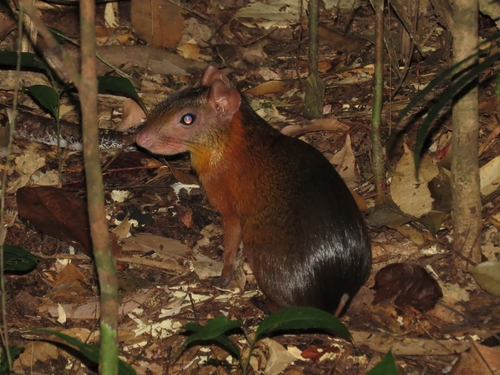
Red Acouchi
Myoprocta acouchy
A vibrant, secretive gem of the Amazonian undergrowth, the Red Acouchi is one of nature's most diligent forest planters. Known for its striking copper coat and energetic personality, this small rodent is a prized find for trail camera enthusiasts.
Quick Identification
Size
30-38 cm (12-15 in) in length; weighs 0.6-1.5 kg (1.3-3.3 lbs)
Colors
Rich reddish-brown to orange-brown upperparts; pale yellowish or orange underside; distinctive white-tipped tail
Key Features
- Vibrant reddish-orange coat
- Slender, long legs built for speed
- Short tail with a prominent white tip
- Large, dark eyes and rounded ears
When You’ll See Them
Geographic range
Where Does the Red Acouchi Live?
Native to the lush northeastern corner of the South American continent, the Red Acouchi is a hallmark species of the Guiana Shield. Its core range encompasses Guyana, Suriname, and French Guiana, stretching into northern Brazil primarily east of the Rio Branco and north of the Amazon River. This species is a lowland specialist, rarely found outside these dense, humid tropical forest environments.
Basemap © OpenStreetMap contributors
Behavior
The Red Acouchi is a strictly diurnal rodent, meaning it is most active during the daylight hours. It spends its time foraging on the forest floor, moving with high-energy, nervous bursts of speed. They are famous for their 'scatter-hoarding' behavior, where they meticulously bury individual seeds and nuts across the forest floor to save for times when food is scarce. This behavior makes them essential to the ecosystem, as they effectively 'plant' the forest when they forget where they hid their stash.
Socially, Red Acouchis are typically solitary or live in small family units consisting of a mated pair and their offspring. They are incredibly high-strung and alert; at the first sign of a predator like a jaguar or a large snake, they emit a sharp whistle and vanish into the dense undergrowth. While they are territorial, they rarely engage in physical combat, preferring to use scent marking to define their boundaries.
EverydayEarth exclusive
Camera Tips
To successfully capture a Red Acouchi on camera, you must think low. Mount your camera no higher than 6 to 10 inches off the ground. Because these rodents are small and low-slung, a standard waist-high mount will likely only capture the top of their heads or miss them entirely. Aim the camera toward natural clearings on the forest floor, especially near the base of large, nut-bearing trees like palms or Brazil nuts.
Speed is the most critical factor when setting up your camera. Red Acouchis are incredibly fast and twitchy. Use a camera with a trigger speed of 0.3 seconds or faster. Set your device to 'Burst Mode' to take 3-5 photos per trigger; this increases your chances of getting a clear shot of the animal rather than just a blur of orange fur. If your camera supports high-frame-rate video (60fps), this is the best way to capture their characteristic tail-flicking and foraging movements.
Since they are diurnal, you don't need to worry much about flash range, but you should be mindful of 'hot spots' caused by dappled sunlight on the forest floor, which can trick PIR sensors or overexpose your images. Positioning the camera in a shaded area facing a well-lit patch of ground often yields the most professional-looking results. While they are naturally shy, placing a few local palm fruits in the center of the frame can entice them to stay still for those precious few seconds needed for a perfect capture.
Similar Species
Species that look similar or are commonly confused with Red Acouchi.
Frequently Asked Questions
Record Red Acouchi at your habitat
Connect a camera to start building your own species record — AI identifies every visitor automatically.