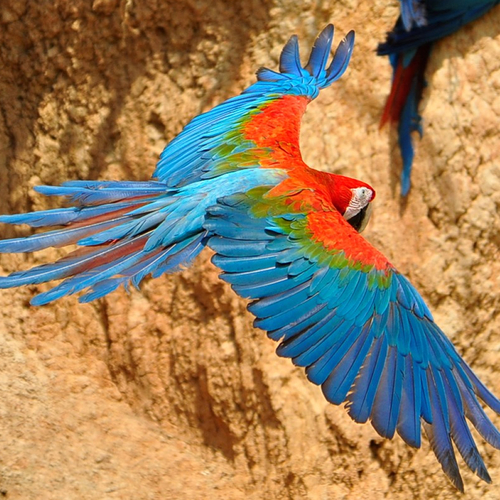
Red-and-green Macaw
Ara chloropterus
The Red-and-green Macaw is a masterpiece of the tropical forest, boasting a massive wingspan and a brilliant crimson coat. Often called the 'gentle giant' of the parrot world, these intelligent birds are as famous for their lifelong pair bonds as they are for their stunning plumage.
Quick Identification
Size
Length: 90-95 cm (35-37 in); Wingspan: 102-122 cm (40-48 in); Weight: 1,050-1,700 g (2.3-3.7 lbs)
Colors
Brilliant crimson red body; green middle wing coverts; blue flight feathers and rump; white facial skin with distinct rows of tiny red feathers.
Key Features
- Distinctive lines of red feathers on white facial skin
- Broad band of green feathers on the wings
- Massive, powerful beak with a pale upper mandible and black lower mandible
- Long, pointed red tail tipped with blue
When You’ll See Them
Behavior
The Red-and-green Macaw is a highly social and intelligent bird, often found in pairs or small family groups. Unlike many other large parrots, they are known for their relatively 'gentle' disposition, though they are still incredibly vocal. They spend a significant portion of their day foraging in the canopy, using their powerful beaks as a 'third foot' to climb through branches and crack open exceptionally hard nuts that other animals cannot access.
In the wild, these macaws are famous for visiting 'clay licks' (collpas), where they gather by the hundreds to consume mineral-rich soil which helps neutralize toxins in their diet. When interacting with humans or camera equipment, they are naturally curious but cautious, often sounding a loud, raucous alarm call if they perceive a threat. They are monogamous and remain with their mate for life, often seen flying so close together that their wingtips nearly touch.
EverydayEarth exclusive
Camera Tips
To capture high-quality footage of Red-and-green Macaws, height is your best friend. These birds rarely descend to the ground except to visit clay licks. If you are setting up a camera in a backyard or forest edge, try mounting it at least 10-15 feet high, overlooking a known fruiting tree or a sturdy horizontal branch used for perching. Angle the camera slightly downward to catch the bird as it lands and stabilizes itself.
Because macaws have such vibrant, contrasting colors, lighting is critical. Avoid pointing your camera directly into the sun, which can cause 'blown out' highlights on their white facial skin. Instead, position the camera to have the sun at its back during peak morning or afternoon hours. This 'golden hour' light will make the crimson and green plumage pop with incredible detail.
Use a fast trigger speed—ideally under 0.4 seconds. While they are large birds, their take-offs and landings are swift. If your camera supports high-definition video, that is often better than stills, as it allows you to record their complex vocalizations and social preening behaviors. Set the video length to at least 20 seconds to ensure you catch more than just a fly-by.
A unique challenge with macaws is their destructive curiosity. They have incredibly powerful beaks and are known to investigate and 'test' new objects in their environment. If you are mounting a camera within their reach, use a heavy-duty metal security housing (bear box) and ensure all cables are tucked away or protected by steel conduit. They can easily snap plastic mounts or chew through standard wiring in seconds.
Finally, consider the seasonal movements of the birds. In many regions, macaws follow the 'fruiting map' of the forest. If you have palm trees on your property, focus your camera efforts during the months when those specific nuts are ripening. Providing a consistent source of fresh water in a high, safe basin can also encourage them to linger in front of your lens.
Similar Species
Species that look similar or are commonly confused with Red-and-green Macaw.
Frequently Asked Questions
Record Red-and-green Macaw at your habitat
Connect a camera to start building your own species record — AI identifies every visitor automatically.