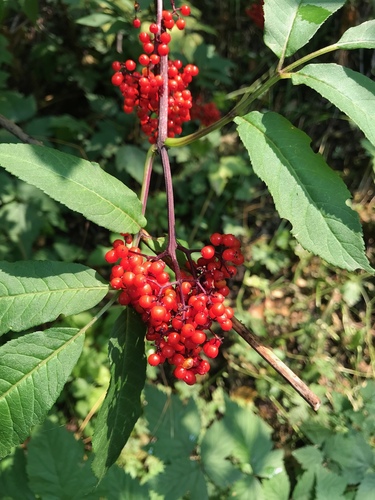
red-berried elder
Sambucus racemosa
A vibrant early-summer beacon for wildlife, the red-berried elder transforms backyards into a bustling avian buffet with its stunning ruby-red fruit clusters.
Quick Identification
Size
Height: 2-6 meters (6-20 feet); Spread: 1.5-4 meters (5-13 feet)
Colors
Bright translucent red berries, creamy-white to yellowish-green flowers, and dark green pinnate leaves
Key Features
- Conical or pyramid-shaped flower and fruit clusters
- Bright red berries appearing in early to mid-summer
- Opposite, pinnate compound leaves with 5-7 leaflets
- Pithy stems with light-colored centers and prominent bark pores
When You’ll See Them
Behavior
Red-berried elder is a vigorous, fast-growing deciduous shrub that plays a critical role as an early-season 'superfood' provider in backyard ecosystems. Unlike many other berry-producing shrubs that fruit in late autumn, this species produces its vibrant red drupes in early summer, providing a vital energy bridge for birds and small mammals when other food sources may still be developing.
The plant is a pioneer species, often the first to colonize forest edges or disturbed garden areas. It grows in a somewhat sprawling, multi-stemmed habit, creating dense thickets that offer excellent nesting cover and protection from predators. While it is hardy and resilient, its branches are notably brittle and pithy, which makes it a favorite for certain cavity-nesting insects and bees that utilize the soft wood for shelter.
EverydayEarth exclusive
Camera Tips
To capture the best action on your red-berried elder, positioning is everything. Because this shrub can grow quite tall and bushy, focus your camera on a specific 'fruiting branch' that is at eye level and has a clear line of sight. Place your camera 3 to 5 feet away on a sturdy tripod or a nearby fence post. Avoid mounting your camera directly to the elderberry branches; they are quite brittle and sway significantly in the wind, which will trigger hundreds of false-positive motion events and quickly drain your battery.
Set your camera to a high-speed burst mode or a short video clip (10-15 seconds). The wildlife visiting these berries, particularly songbirds like Cedar Waxwings, Robins, and Grosbeaks, move with incredible speed. A standard single-photo mode often results in a shot of a blurred wing or an empty branch. By using a fast trigger speed and high sensitivity, you can catch the precise moment a bird plucks a ruby-red berry. If your camera supports a 'Pre-trigger' or 'Buffered' video setting, this is the perfect time to enable it.
Timing your capture is crucial for the best visuals. The translucent red berries look spectacular in the soft, angled light of the early morning, roughly between 7:00 AM and 10:00 AM. This also happens to be the peak foraging time for most avian species. If your camera is positioned in a heavily shaded area, consider using a low-intensity flash or an external LED fill light to make the red colors pop, but ensure the light isn't so harsh that it washes out the delicate texture of the clusters.
Keep a close eye on the ripening process. Red-berried elder fruit transitions from green to bright red very quickly, and once they are fully ripe, a local flock of birds may strip the entire bush in just 48 hours. Start your 'berry watch' in late June and check your camera daily. For those interested in ground-dwelling visitors, place a secondary camera near the base of the shrub; chipmunks and squirrels frequently visit to scavenge the berries dropped by messy eaters in the canopy above.
Similar Species
Species that look similar or are commonly confused with red-berried elder.
Frequently Asked Questions
Record red-berried elder at your habitat
Connect a camera to start building your own species record — AI identifies every visitor automatically.