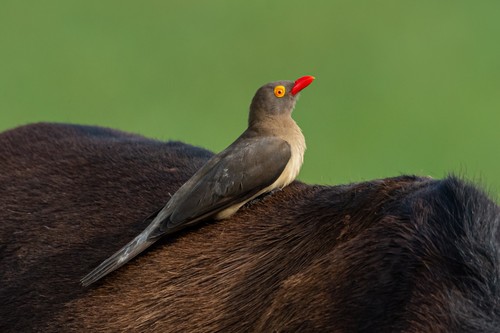
Red-billed Oxpecker
Buphagus erythroryncha
Nature's bravest groomer, the Red-billed Oxpecker, spends its life hitching a ride on Africa's largest mammals. These vibrant birds are more than just hitchhikers; they are a vital alarm system and cleaning crew for the savanna's giants.
Quick Identification
Size
20-22 cm (8-8.7 in) in length; weighs 42-59g (1.5-2.1 oz)
Colors
Olive-brown upperparts and tail with creamy-buff underparts; bright red bill and a prominent yellow eye-ring. Males and females look identical.
Key Features
- Thick bright red bill
- Prominent yellow fleshy eye-ring (wattle)
- Sharp, curved claws for gripping animal hides
- Stiff, pointed tail feathers used for balance
When You’ll See Them
Sightings on EverydayEarth
Aug 1, 2026
A pod of hippopotamuses is cooling off in a river, mostly submerged with just their backs and heads visible. Several Red-billed Oxpeckers are seen perched on the hippos, moving across their skin to feed on parasites.
Aug 1, 2026
Three hippopotamuses are resting on a sun-drenched bank near a woodland area. One large individual lies to the right, while a mother and calf rest closely together on the left. Several small birds, likely red-billed oxpeckers, are seen active on the hippos' backs, occasionally hopping between the resting giants to forage for parasites.
Jul 31, 2026
A large pod of hippopotamuses is gathered at a watering hole. Several individuals are resting on the sunny, muddy bank, while a dozen more are partially submerged in the slow-moving water. A few Black-headed Herons are stationed on rocks and fallen logs throughout the riverbed, keeping watch for prey. Small oxpeckers are seen moving across the backs of the hippos on land, foraging for parasites.
Jul 30, 2026
A massive herd of African buffalo has gathered at a watering hole under the bright midday sun. Many individuals are standing deep in the water to cool off, while a long line of others drinks from the muddy bank. Small oxpeckers are busy flitting between the buffalo, perched on their backs and heads to glean parasites. The scene is one of calm social activity as the herd utilizes this vital water source.
Jul 30, 2026
A pod of six hippopotamuses is seen at a watering hole during the day. Five individuals are resting on the grassy bank, basking in the sun, while a sixth stands partially submerged in the murky water at the bank's edge. Two small oxpeckers are perched on the hide of one resting hippo, likely cleaning it of parasites.
Jul 30, 2026
A group of three hippopotamuses, including a calf, are resting on a sunny riverbank. Several oxpeckers are actively moving across the hippos' backs, foraging for parasites. A spur-winged lapwing stands quietly on the grass nearby.
Behavior
The Red-billed Oxpecker is best known for its complex symbiotic relationship with large African mammals, ranging from buffalo and giraffes to domestic cattle. These birds spend the majority of their daylight hours clinging to the hides of their hosts, moving with a unique, jerky scuttling motion similar to a woodpecker on a tree trunk. They serve as a natural alarm system for their hosts; when they sense a predator, they emit a loud, hissing 'tsirrr' call that alerts the mammal to danger.
While they are primarily seen as helpful 'cleaners' that remove parasites, their behavior is actually more nuanced. They are known to engage in 'wound-feeding,' where they peck at existing scabs or sores to drink the host's blood. Despite this opportunistic feeding, the hosts generally tolerate them due to the significant reduction in tick load. They are highly social birds, often seen in small groups of 2 to 6, and they even perform their courtship and mating rituals right on the backs of their mammalian hosts.
EverydayEarth exclusive
Camera Tips
To capture the Red-billed Oxpecker on camera, your primary strategy should be to target the host animals rather than the birds themselves. Position your AI-powered camera at 'service stations'—areas like waterholes, salt licks, or shaded groves where large mammals like cattle, zebras, or buffalo congregate to rest. Mounting the camera at a height of 3 to 5 feet will provide an eye-level perspective of the host's body, which is where the oxpeckers spend most of their time. Because the birds are small and move rapidly, use a high-sensitivity PIR setting; the host animal’s large heat signature will ensure the camera triggers even if the bird's movement is subtle.
Camera settings are crucial for this species. If your device supports it, use a 'burst' or 'multi-shot' mode. Oxpeckers move in quick, erratic bursts across a hide, and a single photo might catch only a tail or a blurry wing. A shutter speed of at least 1/1000s is recommended to freeze their movement against the host. If you are using a camera with AI recognition, ensure it is set to recognize both 'Bird' and the specific host animal (like 'Cow' or 'Deer') to increase the hit rate of your captures. Use a wide-angle lens rather than a tight zoom; the most compelling shots of this species include the context of their mammalian host.
Timing and light play a big role in getting that perfect shot. The best photos occur during the 'golden hours' of early morning and late afternoon when the low sun angle illuminates the bird’s bright red bill and yellow eye-ring against the often dark or dusty hide of the host. In suburban or farm settings, placing a camera near a rubbing post or a livestock feeder is an excellent way to get close-up, detailed shots. Avoid placing cameras near dense brush where the movement of branches might cause false triggers, as the oxpecker’s presence is best documented in the open savanna or pasture.
Similar Species
Species that look similar or are commonly confused with Red-billed Oxpecker.
Frequently Asked Questions
Record Red-billed Oxpecker at your habitat
Connect a camera to start building your own species record — AI identifies every visitor automatically.