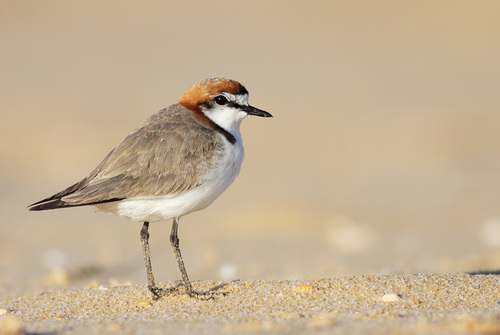
Red-capped Plover
Anarhynchus ruficapillus
A tiny, spirited shorebird that brings a dash of rufous color to the water's edge. Watch as the Red-capped Plover scampers across the sand with unmatched agility and charm.
Quick Identification
Size
14–16 cm (5.5–6.3 in) long; 27–34 cm (10.5–13.5 in) wingspan; 35–50 g (1.2–1.8 oz) weight
Colors
Males have a bright rufous crown and nape with a black eye-stripe; females are paler with sandy-brown crowns. Both have white underparts and grey-brown wings.
Key Features
- Bright reddish-brown (rufous) cap and neck on males
- Distinct black line from the bill through the eye
- Small, thin black bill and dark legs
- White forehead and underparts
When You’ll See Them
Behavior
The Red-capped Plover is a charismatic shorebird known for its high-energy "run-and-pause" foraging style. They dart across the sand with incredible speed, suddenly freezing in place to scan for movement before dipping their heads to snatch a tiny invertebrate. This staccato movement is a signature trait of the plover family and makes them a joy to watch on camera.
During the breeding season, these birds are fiercely protective of their nests, which are nothing more than simple scrapes in the sand or gravel. If a predator or human gets too close, the adults often perform a convincing "broken-wing display," fluttering along the ground as if injured to lure the threat away from their camouflaged eggs. While they are usually seen in pairs, they may congregate in larger loose flocks at rich feeding grounds during the non-breeding months.
EverydayEarth exclusive
Camera Tips
To capture high-quality footage of the Red-capped Plover, you must get your camera down to their level. These birds are diminutive and spend their entire lives on the ground, so mounting your AI camera just 5 to 10 inches above the substrate is essential. A low-angle perspective not only captures the bird's intricate feather details but also provides a more intimate, professional look by creating a soft, blurred background behind the subject.
Strategic placement is key to consistent captures. Look for the "wrack line"—the line of seaweed and debris left by the high tide—as this is where their prey is most concentrated. In backyard environments bordering coastal areas, place cameras near shallow depressions or open sandy patches where the birds may seek shelter from the wind. Avoid placing cameras directly on suspected nest sites to prevent disturbing the birds or inadvertently leading predators to the eggs; instead, focus on the paths they take between the dunes and the water's edge.
Because these plovers move with lightning-fast bursts of speed, your camera settings need to be optimized for action. Use a high shutter speed or "Sport" mode if available, and set your AI trigger to high sensitivity to ensure the camera catches the bird before it darts out of the frame. If your camera supports it, recording in 60fps (frames per second) will allow you to play back their rapid movements in smooth slow-motion, revealing the fascinating mechanics of their foraging.
Lighting can be a challenge on open beaches. To avoid harsh shadows or overexposed white feathers, try to position your camera so it faces away from the sun during the early morning or late afternoon. The warm "golden hour" light enhances the rufous tones of the male's cap beautifully. If you are monitoring a tidal area, check the local tide charts; the best activity usually occurs on a falling tide when new mudflats and sandbars are being exposed.
Similar Species
Species that look similar or are commonly confused with Red-capped Plover.
Double-banded Plover
The Double-banded Plover has two distinct bands across its breast, whereas the Red-capped Plover has a plain white breast and a bright rufous crown.
Hooded Plover
Hooded Plovers are larger with a completely black head and a striking red ring around the eye, lacking the rufous cap of the Red-capped.
Frequently Asked Questions
Record Red-capped Plover at your habitat
Connect a camera to start building your own species record — AI identifies every visitor automatically.