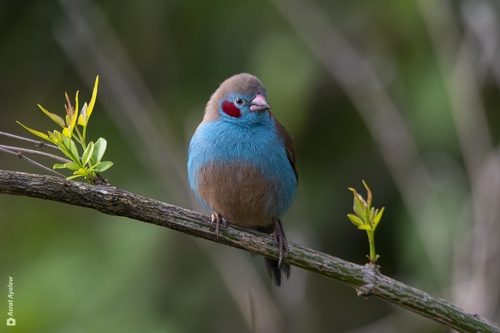
Red-cheeked Cordonbleu
Uraeginthus bengalus
With their stunning sky-blue plumage and charming red 'blush,' the Red-cheeked Cordonbleu is one of Africa’s most beloved backyard visitors. These tiny, social finches bring a splash of color and a cheerful song to gardens and savannas alike.
Quick Identification
Size
Length: 12–13 cm (4.7–5.1 in); Weight: 8.9–11 g (0.31–0.39 oz)
Colors
Cyan-blue face, breast, and tail with sandy-brown upperparts. Males feature a distinct crimson-red patch on each cheek, while females are paler blue and lack the red patch.
Key Features
- Vibrant sky-blue underparts and tail
- Bright red cheek patches (males only)
- Short, conical pinkish-grey bill
- Frequent tail-flicking movement
When You’ll See Them
Geographic range
Where Does the Red-cheeked Cordonbleu Live?
Native to the African continent, the Red-cheeked Cordonbleu thrives across a vast belt of Sub-Saharan Africa. Its core range extends from Senegal and Mali in West Africa, stretching eastward through the Sahel to Ethiopia and Somalia, and reaching south into Kenya, Tanzania, and parts of Zambia and Angola. While they are strictly resident birds in their native range, small localized populations have occasionally been reported in other tropical regions due to the caged bird trade.
Basemap © OpenStreetMap contributors
Behavior
The Red-cheeked Cordonbleu is a social and energetic finch, often found in pairs or small family groups. They are frequently seen foraging on the ground, hopping with a characteristic upright posture as they search for fallen seeds and small insects. During the breeding season, males perform a charming courtship display that involves holding a piece of dried grass in their beak while hopping up and down on a branch in a rhythmic 'dance' to impress a mate.
These birds have adapted remarkably well to human presence and are a common sight in African gardens and villages. They are relatively tame and will often allow people to approach within a few meters. Unlike some more skittish finches, Cordonbleus are highly vocal, maintaining contact with their partners through a series of thin, high-pitched 'tsee-tsee' calls that are a staple sound of the African savanna and suburban parklands.
EverydayEarth exclusive
Camera Tips
To capture the best footage of Red-cheeked Cordonbleus, position your AI camera close to the ground, as these birds spend a significant portion of their day foraging in the dirt. A height of 15 to 30 centimeters (6 to 12 inches) is ideal. If you are using a tripod or a stake, ensure the lens is aimed at a clear patch of earth or a flat rock where you have scattered fine seeds like white millet or nyjer seed.
Water is one of the strongest magnets for this species. In drier environments, a shallow birdbath or even a small dripping water feature will attract them for daily drinking and bathing sessions. Because they are small and fast-moving, set your camera to its highest possible frame rate (60fps if available) to avoid motion blur during their quick hops and wing flutters. Ensure the area is well-lit, as their brilliant blue plumage truly 'pops' under direct morning sunlight.
Avoid placing the camera in dense shadows, as the lack of light will make the male’s red cheek patch look dark and indistinguishable from the rest of the head. If you are monitoring a backyard, place the camera near low-hanging shrubbery or 'escape cover'—Cordonbleus feel safest when they have a quick place to hide from hawks. Early morning just after sunrise is the peak time for activity, as they are among the first birds to begin feeding once the sun is up.
Frequently Asked Questions
Record Red-cheeked Cordonbleu at your habitat
Connect a camera to start building your own species record — AI identifies every visitor automatically.