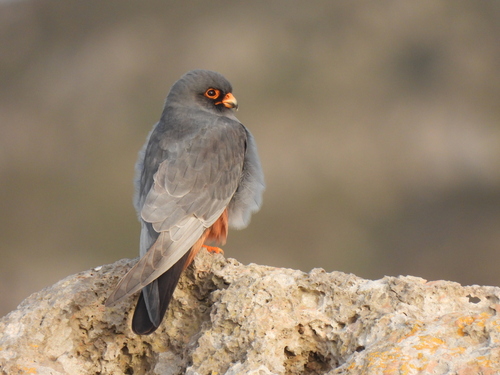
Red-footed Falcon
Falco vespertinus
A social and striking raptor, the Red-footed Falcon is famous for its elegant slate-grey plumage and vibrant orange 'trousers.' Witness the acrobatic grace of one of the few birds of prey that prefers the company of a colony.
Quick Identification
Size
Length: 28–34 cm (11–13 in); Wingspan: 65–75 cm (26–30 in); Weight: 130–197 g (4.6–7.0 oz)
Colors
Males are distinctive slate-grey with reddish-orange thighs and undertail; females have buff-orange heads and underparts with grey barred backs and a dark eye-mask.
Key Features
- Slate-grey body with striking red-orange legs and 'trousers' (males)
- Buff-orange crown and belly with a black 'mustache' mask (females)
- Bright orange or red cere (skin at base of beak) and eye-rings
- Social nesting behavior often utilizing old crow nests
When You’ll See Them
Behavior
The Red-footed Falcon is a remarkably social raptor, often seen hunting in loose groups or nesting in colonies. Unlike many solitary birds of prey, these falcons are gregarious, especially during migration and on their wintering grounds in Africa. They have a light, buoyant flight and are frequently seen hovering in the wind or 'wind-hovering' while scanning the ground for prey.
These birds are long-distance migrants, traveling thousands of miles between Eurasia and Southern Africa. Because they do not build their own nests, they rely heavily on the presence of corvids (like rooks and crows), moving into abandoned nests in shelterbelts or small groves of trees. They are generally tolerant of human presence if not directly disturbed, making them a delight for patient wildlife observers.
EverydayEarth exclusive
Camera Tips
To capture a Red-footed Falcon on a trail camera, you must focus on 'sentinel perches.' These falcons love to survey open hunting grounds from a high vantage point. Look for isolated dead trees, fence posts, or even utility wires overlooking a meadow. If you have a tall, sturdy pole in your yard, mounting a camera with a view of the top (or placing the camera on a nearby structure aimed at the pole) is your best bet. Use a fast trigger speed setting, as raptors can land and depart in the blink of an eye.
While they won't visit a traditional seed feeder, Red-footed Falcons are highly attracted to water, especially in drier environments. A large, ground-level birdbath or a shallow pond feature in an open area can draw them in for spectacular bathing and drinking shots. Position your camera about 2 to 3 feet off the ground, angled slightly downward toward the water's edge, and ensure you have a fast enough shutter speed to freeze the water droplets during a vigorous wing-splash.
If you are using an AI-powered camera like a Birdfy or similar, place it near an area where large insects are abundant. High-grass meadows or gardens with native wildflowers that attract dragonflies and grasshoppers provide the ultimate hunting ground. These birds are most active during the golden hours of the morning and late afternoon, so ensure your camera's sensitivity is optimized for those lighting conditions.
During migration peaks in late spring or late summer, these birds may roost together. If you notice a particular grove of trees where several falcons are congregating, mounting a camera on a trunk facing a common roosting branch can yield incredible group photos. Since they are migratory, timing is everything—keep your cameras active and high-capacity SD cards ready during the peak passage months of May and September.
Similar Species
Species that look similar or are commonly confused with Red-footed Falcon.
Amur Falcon
Nearly identical, but the male Amur Falcon has white underwing coverts, whereas the Red-footed Falcon's are dark grey.
Eurasian Hobby
The Hobby has a more distinct 'broken' mustache mask and vertical streaks on the chest, whereas the Red-footed Falcon has a cleaner or more barred appearance.
Frequently Asked Questions
Record Red-footed Falcon at your habitat
Connect a camera to start building your own species record — AI identifies every visitor automatically.