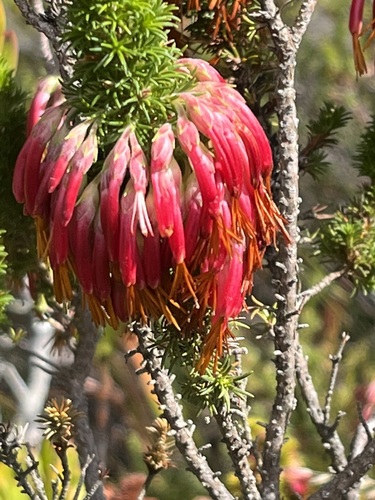
Red Heath
Erica coccinea
A vibrant icon of the South African fynbos, the Red Heath dazzles with its drooping tubular bells and serves as a vital nectar source for iridescent sunbirds.
Quick Identification
Size
A small to medium shrub reaching 0.3–1.2 metres (1–4 feet) in height with a spread of approximately 0.5 metres (1.6 feet).
Colors
Highly variable flower colors including vivid scarlet, bright orange, yellow, and occasionally greenish-white; leaves are dark green.
Key Features
- Drooping, tubular flowers that hang in clusters near the ends of branches
- Small, needle-like leaves arranged in whorls of three
- Prominent, dark-colored anthers that often protrude slightly from the corolla
- Sticky or slightly hairy texture on the floral tubes
When You’ll See Them
Geographic range
Where Does the Red Heath Live?
Native to the African continent, the Red Heath is a jewel of the Western Cape province in South Africa. Its core range extends from the iconic Table Mountain and the Cape Peninsula eastward through the Hottentots Holland Mountains and into the Overberg region, with isolated populations reaching into the Free State. This species is a hallmark of the Cape Floristic Region, one of the most biodiverse botanical areas on Earth.
Basemap © OpenStreetMap contributors
Behavior
The Red Heath is a quintessential member of the fynbos ecosystem, exhibiting a fascinating 'reseeder' life strategy. Unlike some plants that sprout from woody rootstocks after a wildfire, this species relies on seeds stored in the soil. When a fire sweeps through the Cape mountains, the adult plants perish, but the intense heat and subsequent smoke chemicals trigger the germination of a new generation, ensuring the species' survival in a fire-driven landscape.
As a specialist in attracting avian visitors, the Red Heath has evolved a symbiotic relationship with sunbirds, particularly the Orange-breasted Sunbird. The downward-hanging, tubular flowers are perfectly shaped for the curved bills of these birds. While feeding on the energy-rich nectar, the sunbirds inadvertently collect pollen on their heads, transporting it from one bush to another. This interaction makes the Red Heath a focal point of activity for backyard wildlife enthusiasts in its native range.
EverydayEarth exclusive
Camera Tips
To capture the Red Heath effectively, position your camera at a mid-level height (about 0.5 to 1 meter off the ground) to align directly with the drooping flower clusters. Because this plant is a magnet for sunbirds, your camera settings should prioritize a fast shutter speed—at least 1/1000th of a second—to freeze the rapid wing movements of birds visiting the blooms. Use a macro lens or a close-focusing trail camera to highlight the intricate, sticky texture of the tubular flowers.
Since the Red Heath is static, the real challenge is capturing the interaction. Do not use artificial lures or sugar water near the plant; the natural nectar is the primary draw. Instead, focus on the 'golden hour'—the hour after sunrise or before sunset—when the low-angle light illuminates the translucent red petals, making them appear to glow from within. This light also highlights the iridescent feathers of visiting pollinators.
Placement is key: look for a specimen that is slightly isolated from dense brush to ensure your AI camera has a clear line of sight and won't be triggered by swaying branches in the background. If you are using an AI-powered backyard camera, ensure the lens is clean of pollen and sticky residue, as these plants can be quite resinous. Checking the camera after a rainstorm is also recommended, as the water droplets clinging to the tubular bells create stunning, high-contrast photographic opportunities.
Frequently Asked Questions
Record Red Heath at your habitat
Connect a camera to start building your own species record — AI identifies every visitor automatically.