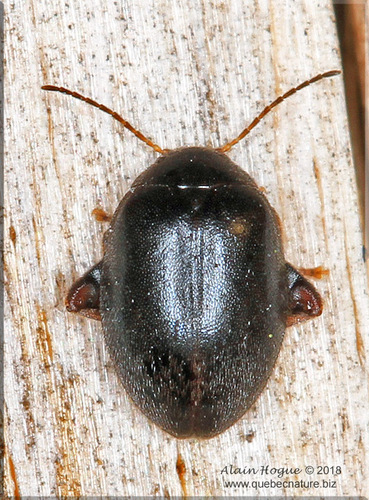
Red-legged Marsh Beetle
Scirtes tibialis
A tiny master of the leap, the Red-legged Marsh Beetle brings a splash of color and incredible agility to the edges of your backyard pond. This pint-sized jumper is a key indicator of a healthy, thriving wetland ecosystem.
Quick Identification
Size
2.5–3.5 mm (0.10–0.14 inches) in length
Colors
Dark brown to black body with contrasting reddish-orange or yellowish legs; antennae are typically dark at the tips and lighter at the base.
Key Features
- Broadly oval and convex body shape
- Greatly enlarged hind femora (thighs) designed for jumping
- Contrasting reddish-orange legs against a dark torso
- Short, fine yellowish hairs visible under magnification
When You’ll See Them
Behavior
While the larvae are fully aquatic, the adults spend their lives in the humid microclimates of tall grasses, sedges, and wetland vegetation. They are most active during the warmest parts of the day, often seen basking or feeding on the undersides of foliage. They are not known to be social, typically appearing as solitary individuals or in small, unorganized groups where food is abundant.
EverydayEarth exclusive
Camera Tips
Capturing the Red-legged Marsh Beetle requires a specialized approach because of its tiny size and habitat. Standard trail cameras will not trigger for an insect this small; instead, use an AI-powered macro camera or a lens setup specifically designed for close-up photography. Place your camera setup on a stable mini-tripod at the edge of a pond or marshy area, focusing on the leaves of aquatic plants like pickerelweed, sedges, or cattails. The lens should be positioned within 2 to 4 inches of the foliage for maximum detail.
Since these beetles are dark-colored and somewhat glossy, lighting is your biggest challenge. Harsh, direct midday sun can cause reflective 'hot spots' on their wing covers, obscuring the detail of their namesake red legs. Use a small diffuser or wait for slightly overcast conditions to achieve soft, even lighting that brings out the subtle textures and colors of the beetle's exoskeleton. Setting your camera to a fast shutter speed (at least 1/500s) is essential to catch them before they spring out of the frame.
To increase your chances of a sighting, look for 'seep' areas where the soil is constantly saturated. You can encourage them to stay in the frame by providing a damp piece of driftwood or a flat, mossy stone near the water's edge. Because they are attracted to high humidity, early morning before the dew evaporates is a great time to find them moving slowly, though they reach peak activity when the sun warms their environment. Keep your camera's motion sensitivity at its highest setting if using an AI trigger system.
Frequently Asked Questions
Record Red-legged Marsh Beetle at your habitat
Connect a camera to start building your own species record — AI identifies every visitor automatically.