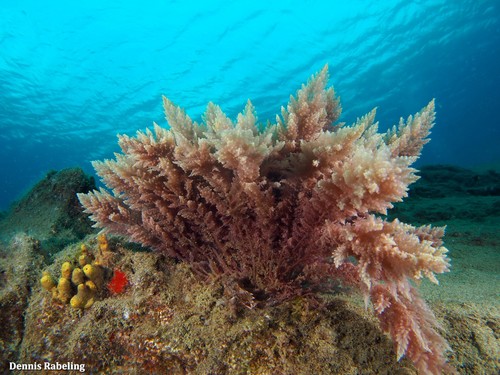
red sea plume
Asparagopsis taxiformis
The red sea plume is a striking underwater marvel that looks more like a delicate pink feather than a seaweed. Beyond its beauty, this remarkable alga is a scientific powerhouse, currently being studied for its incredible ability to slash methane emissions in livestock.
Quick Identification
Size
Gametophyte plumes reach 5-15 cm (2-6 inches) in height; tetrasporophyte clumps are 1-3 cm (0.4-1.2 inches) wide
Colors
Vibrant rose-pink, deep reddish-purple, or brownish-maroon; may fade to translucent tan in high sun
Key Features
- Feathery, fern-like plume structure
- Radial branching from a central translucent stem
- Two distinct life stages (feathery plume vs. cotton-candy clump)
- Strong, slightly chemical or 'ocean' scent when fresh
When You’ll See Them
Behavior
The red sea plume is a complex red alga characterized by a fascinating 'alternation of generations.' It exists in two completely different physical forms: the upright, feathery plume (gametophyte) and a fuzzy, pink, puffball-like stage known as the 'Falkenbergia' stage (tetrasporophyte). While it may look delicate, it is chemically formidable. It produces bromoform and other halogenated compounds as a natural defense mechanism, which discourages most fish and sea urchins from grazing on it.
In marine ecosystems, it typically anchors itself to rocky substrates or coral rubble using tiny, root-like structures called haptera. It is highly sensitive to water temperature and is usually found in warm, tropical, or subtropical currents. For humans, it has long been a prized edible seaweed in Hawaiian culture, known as 'Limu kohu,' valued for its pungent, peppery flavor and iodine-rich profile.
EverydayEarth exclusive
Camera Tips
To capture the red sea plume, you’ll need to move your gear from the backyard into the 'blue backyard' of the coastline. An underwater action camera or a trail camera inside a high-quality waterproof housing is essential. The best placement is in a shallow tide pool or on the leeward side of a rocky reef shelf. Aim for a depth of 1 to 3 feet during low tide, which allows enough sunlight to penetrate and illuminate the seaweed's deep red pigments without the washing-out effect of deep water.
Unlike land animals, the red sea plume doesn't 'move' from place to place, but it is in constant motion due to surge and currents. Avoid using motion-trigger settings, as the swaying branches will cause thousands of false triggers. Instead, utilize a time-lapse mode set to capture a frame every 5 to 10 seconds. This will allow you to create a beautiful video showing the 'underwater wind' as the plumes dance in the current. If your camera has manual white balance settings, set it to 'underwater' or 'cloudy' to help counteract the blue tint of the water and bring out the natural pinks and reds.
Position your camera at a low angle, looking slightly upward toward the surface if possible; this silhouetting effect can highlight the fine, feathery details of the branches. For lighting, midday is your best friend. When the sun is directly overhead, it pierces the water column with the least amount of reflection. If you are shooting in a shaded tide pool, a small waterproof LED video light can help pop the colors. Be sure to securely anchor your camera using a weighted tripod or a 'clamp mount' attached to a heavy rock, as even a small wave can easily carry away your equipment.
Frequently Asked Questions
Record red sea plume at your habitat
Connect a camera to start building your own species record — AI identifies every visitor automatically.