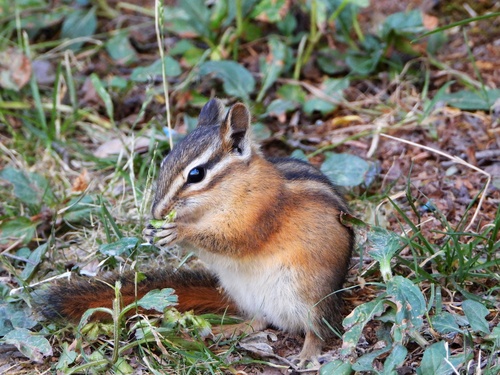
Red-tailed Chipmunk
Neotamias ruficaudus
The Red-tailed Chipmunk is the fiery-colored acrobat of the Northern Rockies, distinguished by its vibrant russet tail and energetic mountain lifestyle.
Quick Identification
Size
Total length 22-25 cm (8.7-9.8 in); weight 50-70 g (1.8-2.5 oz)
Colors
Greyish-brown upper body with five dark dorsal stripes; most distinguished by the bright reddish-orange (rufous) underside of the tail.
Key Features
- Vibrant reddish-orange underside of the tail
- Five dark stripes along the back separated by four lighter stripes
- Prominent white stripes above and below the eyes
- Relatively large and robust compared to other western chipmunks
When You’ll See Them
Behavior
Red-tailed chipmunks are the acrobats of the mountain forests. Unlike many of their cousins who prefer to stay grounded, these chipmunks are remarkably arboreal, often seen scurrying high into the canopies of subalpine firs and Engelmann spruces to harvest cones. They are highly territorial and will defend their preferred foraging spots with a series of sharp 'chip' and 'chuck' vocalizations.
In the wild, they are solitary creatures except during the breeding season. They are industrious foragers, spending much of the late summer and early autumn gathering seeds to store in underground burrows for the winter. While they do hibernate, they don't store body fat like bears; instead, they wake up periodically throughout the winter to snack on their hidden caches.
EverydayEarth exclusive
Camera Tips
To capture high-quality footage of a Red-tailed Chipmunk, you need to think vertically. While standard trail cameras are often pointed at the ground, these chipmunks love 'wildlife highways'—fallen logs, low-hanging branches, and stone walls. Mount your camera about 12 to 18 inches off the ground, aiming it along the length of a fallen log. This increases the 'dwell time' the animal spends in the frame as it traverses the log.
Baiting can be very effective for bringing them into focus. A small pile of black oil sunflower seeds or raw, unsalted peanuts placed on a flat mossy rock or stump will keep them stationary long enough for a clear shot. If you want to see their unique climbing behavior, try wedging a cob of dried corn or a handful of seeds into the bark of a tree at chest height and angling your camera upward.
Because these animals are incredibly fast, camera settings are crucial. Use a 'High' or 'Fast' trigger speed setting to avoid capturing just a blur of a tail. A short trigger interval of 0.5 to 1 second is ideal. If your camera has a burst mode, set it to take 3-5 photos per trigger. This ensures you get at least one sharp image where the stripes and the red tail underside are clearly visible for identification.
Seasonality plays a big role in your success. The best time to deploy your camera is late August through September. During this period, their 'caching' instinct kicks in, and they become much more active and less cautious as they frantically gather food for the winter. Look for areas with heavy cone crops or nearby berry bushes to find the highest concentration of activity.
Similar Species
Species that look similar or are commonly confused with Red-tailed Chipmunk.
Frequently Asked Questions
Record Red-tailed Chipmunk at your habitat
Connect a camera to start building your own species record — AI identifies every visitor automatically.