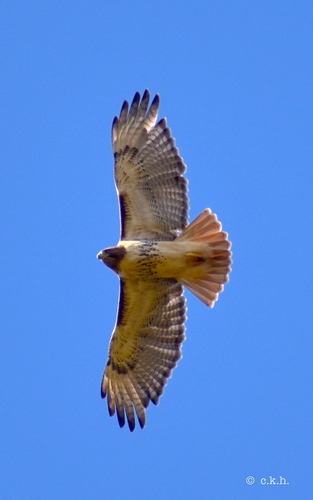
Red-tailed Hawk
Buteo jamaicensis
The Red-tailed Hawk is the quintessential guardian of the open sky, known for its piercing gaze and iconic cinnamon tail. A common sight in backyards and highways alike, this powerful raptor is a master of the aerial hunt.
Quick Identification
Size
Length: 18-26 in (45-65 cm); Wingspan: 43-57 in (110-145 cm); Weight: 1.5-3.5 lbs (0.7-1.6 kg)
Colors
Typically chocolate-brown above and pale below with a streaked belly band; adults have a signature cinnamon-red upper tail
Key Features
- Broad, rounded wings with dark bars on the leading edges
- Short, wide tail that turns brick-red in adults
- Streaked 'belly band' across an otherwise pale underside
- Stocky build with a hooked beak and yellow talons
When You’ll See Them
Sightings on EverydayEarth
May 17, 2026
A Red-tailed Hawk is perched on the leaf-littered ground in a sunlit clearing. After a few moments of scanning the area, it takes flight, swooping low toward the camera and banking to the right, showing its distinctive tail and wing patterns before disappearing into the forest canopy.
Mar 23, 2026
A Red-tailed Hawk is briefly visible at the top right of the frame as it flies past the camera, showing its distinctively barred tail and wings. The rest of the wooded clearing is quiet with no other visible wildlife activity.
Jul 22, 2026
An adult Red-tailed Hawk is perched on a thick branch overlooking a large stick nest. The bird remains alert, scanning the valley below and turning its head several times before taking flight and exiting the frame to the left.
Jun 20, 2026
A Red-tailed Hawk is perched on a branch to the left of a large stick nest, repeatedly giving its distinctive high-pitched scream. Inside the nest, a young hawk chick is visible resting among the branches.
Jun 20, 2026
A Red-tailed Hawk is perched on a branch overlooking a large, empty raptor nest. It remains alert and stationary, occasionally turning its head to scan the green valley and river in the background.
Jun 20, 2026
An adult Red-tailed Hawk is perched on a branch just to the left of a large, empty stick nest. The hawk is seen vocalizing with its beak open while observing the lush green valley and river in the background.
Behavior
Red-tailed Hawks are masters of the sky, often seen soaring in wide circles or perched stoically on telephone poles overlooking open fields. They are highly territorial raptors that use their incredible eyesight—about eight times more powerful than a human's—to spot small movements in the grass from hundreds of feet in the air. While they are solitary hunters, they often pair for life, performing impressive aerial displays during courtship where they lock talons and spiral toward the earth.
In suburban environments, these hawks have become remarkably well-adapted to human presence. They utilize man-made structures like stadium lights and skyscrapers as vantage points for hunting. While they generally avoid direct interaction with people, they are bold enough to nest in backyard trees if the food supply is consistent. Their iconic, raspy 'kee-ee-arr' scream is so intimidating that it is frequently used in Hollywood movies as a stand-in for the sound of a Bald Eagle.
EverydayEarth exclusive
Camera Tips
To capture a Red-tailed Hawk on your backyard camera, you need to think vertically. Unlike ground-dwelling wildlife, these hawks rarely spend time on the forest floor unless they have just made a kill. Position your camera to face a prominent, sturdy 'sentinel' perch—such as a fence post, a dead tree limb (snag), or the top of a pergola. Ensure the camera is angled slightly upward and has a clear line of sight, as these birds prefer perches that offer a 360-degree view of their surroundings.
Because hawks are triggered by movement and are lightning-fast, you should prioritize a camera with a high trigger speed (0.2 seconds or less) and a fast recovery time. If your camera supports 'Burst Mode' or 'Photo + Video,' enable it; capturing the moment the hawk unfolds its massive wings to take flight is the holy grail of backyard bird photography. Set your PIR (passive infrared) sensitivity to 'High' to ensure the sensor picks up the bird’s heat signature against the cooler sky or foliage.
Lighting is your biggest challenge when shooting upward. To avoid 'silhouetting'—where the bird appears as a black shadow against a bright sky—place your camera so the sun is behind it during the peak mid-morning hunting hours. If you have a bird bath, you might occasionally catch a Red-tailed Hawk dropping down for a drink or a dip, but their primary draw to your yard will be the presence of squirrels or songbirds. Avoid using birdseed as a direct lure, as hawks are strictly carnivorous, but maintaining a healthy bird feeder station will naturally attract the prey that brings the hawks into your camera's field of view.
Similar Species
Species that look similar or are commonly confused with Red-tailed Hawk.
Red-shouldered Hawk
Smaller with a heavily barred reddish-orange chest and a black-and-white banded tail.
Cooper's Hawk
Leaner build with shorter, rounded wings and a much longer tail; typically hunts songbirds in dense cover.
Swainson's Hawk
Possesses a dark 'bib' on the upper chest and longer, more pointed wings compared to the Red-tail.
Frequently Asked Questions
Record Red-tailed Hawk at your habitat
Connect a camera to start building your own species record — AI identifies every visitor automatically.