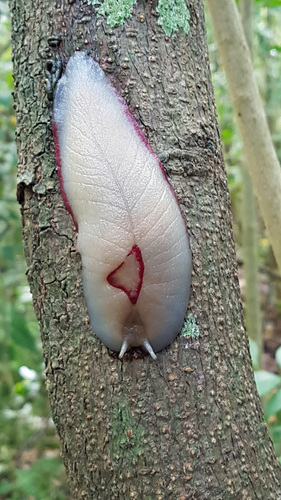
Red Triangle Slug
Triboniophorus graeffei
Australia's largest native land slug is a colorful forest cleaner, famous for the striking red triangle on its back and its unique 'leaf-vein' skin patterns.
Quick Identification
Size
Averages 10–14 cm (4–5.5 inches) in length, with some individuals reaching up to 15 cm (6 inches).
Colors
Typically creamy-white, light grey, or yellow with a vivid red or fluorescent orange triangle on the back; some populations in high altitudes can appear bright pink.
Key Features
- Distinctive red or orange triangle surrounding the breathing pore
- Deeply pigmented 'leaf-vein' grooves across the back
- Single pair of retractable tentacles (not two like garden slugs)
- Large, fleshy body with a smooth, moist texture
When You’ll See Them
Geographic range
Where Does the Red Triangle Slug Live?
The Red Triangle Slug is native to the eastern coast of Australia, where it thrives in the humid corridor between the Great Dividing Range and the Pacific Ocean. Its range begins in the tropical rainforests of North Queensland and extends southward through the temperate woodlands of New South Wales, reaching as far south as the Sydney region. Within this territory, it is a common resident in both pristine wilderness and established urban green spaces where native trees are preserved.
Basemap © OpenStreetMap contributors
Behavior
The Red Triangle Slug is a nocturnal specialist that spends its life cleaning the bark of Australia's native trees. Unlike the invasive garden slugs many homeowners are used to, this native species is not a pest; it does not eat garden vegetables or ornamental plants. Instead, it emerges at night—especially during or after rainfall—to glide slowly across smooth surfaces in search of its microscopic food sources.
These slugs are solitary but can occasionally be found in small groups on a single tree trunk if the algae growth is particularly lush. They have a fascinating defense mechanism: when touched or threatened, they can secrete a remarkably sticky, high-viscosity mucus that makes them difficult for birds or small mammals to swallow. They are well-adapted to the vertical world of the forest, using their muscular foot to navigate high into the canopy.
EverydayEarth exclusive
Camera Tips
To capture high-quality footage of the Red Triangle Slug, you must think vertically. These slugs spend most of their time on tree trunks rather than the ground. Look for smooth-barked trees like Eucalyptus (Gum trees) or Angophoras in your yard. Mount your camera directly to the trunk at chest height, angling it slightly upward or downward to catch the slug as it traverses the bark. Because they move at a literal 'snail's pace,' set your camera to take short 10-second video clips or photo bursts with a very short trigger delay to ensure you don't miss the subtle undulations of their movement.
Lighting is your biggest challenge. Since these mollusks are strictly nocturnal and emerge during rain, your camera needs a good infrared (IR) sensor. However, because the slug's body is often pale and moist, it can be highly reflective. If your camera allows for adjustable IR intensity, turn it down slightly to avoid 'white-out' on the slug's body. If you are using a white-light flash, place a small piece of semi-transparent tape over the flash to diffuse the light, which will better highlight the vibrant red triangle and the 'leaf-vein' texture on their skin.
You can encourage a visit by creating a 'micro-habitat' in your camera's field of view. On a dry evening, lightly spray a patch of smooth bark with de-chlorinated water (rainwater is best). The increase in local humidity will often draw slugs out from their daytime hiding spots under leaf litter or loose bark. Avoid using any chemical fertilizers or snail pellets in the area, as these are highly toxic to this native species and will prevent them from visiting your camera site.
Frequently Asked Questions
Record Red Triangle Slug at your habitat
Connect a camera to start building your own species record — AI identifies every visitor automatically.