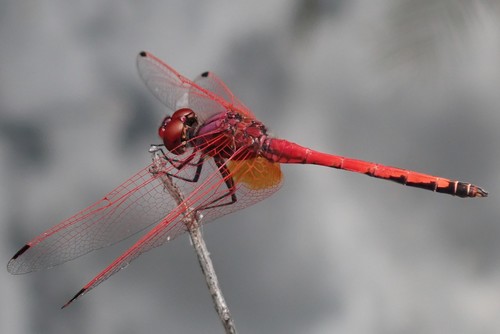
Red-veined Dropwing
Trithemis arteriosa
A scarlet sentinel of the garden pond, the Red-veined Dropwing is famous for its brilliant crimson hue and its unique habit of resting with its wings tilted forward. This agile aerial hunter is a favorite for backyard observers and a natural ally in mosquito control.
Quick Identification
Size
Total length of 32-36 mm (1.2-1.4 inches); wingspan of approximately 55-60 mm (2.1-2.4 inches)
Colors
Adult males are brilliant scarlet-red with red wing veins; females and immature males are ochre-yellow or golden-brown with yellow wing veins.
Key Features
- Vivid red veins concentrated at the base of the wings
- Characteristic 'dropwing' posture with wings held forward and down
- Small black wedge-shaped markings on segments 8-10 of the abdomen
When You’ll See Them
Behavior
The Red-veined Dropwing is a classic 'percher' dragonfly, spending much of its day stationed on a prominent twig, reed, or garden stake. It is named for its distinctive resting posture, where it holds its wings tilted forward and downward. This pose is more than just a stylistic choice; it helps the dragonfly regulate its body temperature and allows for an explosive, instantaneous takeoff to intercept prey or chase away rivals.
Highly territorial and aggressive, males will patrol a specific stretch of a pond or stream, frequently returning to the exact same perch after a sortie. They are bold around humans and can be surprisingly approachable if you move slowly. In the heat of the day, they may adopt the 'obelisk' posture, pointing their abdomen straight up toward the sun to minimize the surface area exposed to direct heat.
EverydayEarth exclusive
Camera Tips
To successfully capture a Red-veined Dropwing on your backyard camera, you must focus on 'perch-point' placement. These dragonflies are highly habitual and will return to the same sun-drenched twig dozens of times an hour. Identify a tall, vertical reed or a thin branch that sticks out over a water source and position your camera exactly 18 to 24 inches away. If your camera has a macro mode or adjustable focus, this is the time to use it.
Lighting is the most critical factor for dragonflies. Because their red coloration and wing veins are best highlighted by direct sunlight, place your camera facing north or south (to avoid lens flare) while ensuring the perch itself is bathed in midday sun. The red pigments in the male's body and wing veins virtually glow when hit by high-angle sunlight, which will help your AI-powered camera trigger more reliably against a darker background of water or foliage.
For the best results, use a high-speed trigger setting. Dragonflies are incredibly fast, and a standard 'motion' trigger might only catch a blur or a tail. If your camera allows for pre-buffered video or a high-frame-rate 'burst' of photos, enable it. You don't need bait or lures for these insects; instead, provide 'structural bait' by placing an attractive, slender bamboo stake in a sunny spot near your birdbath or pond. They find these vantage points irresistible for hunting.
Similar Species
Species that look similar or are commonly confused with Red-veined Dropwing.
Frequently Asked Questions
Record Red-veined Dropwing at your habitat
Connect a camera to start building your own species record — AI identifies every visitor automatically.