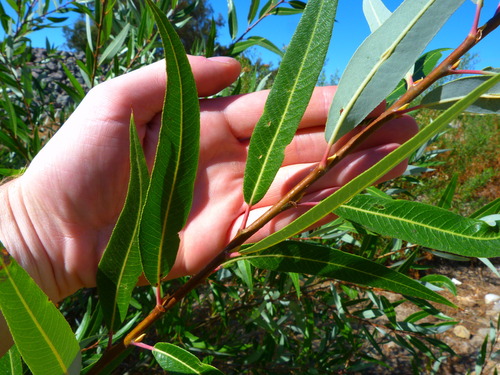
red willow
Salix laevigata
A vibrant anchor of Western waterways, the red willow is more than just a tree—it's a bustling high-rise for pollinators and songbirds. With its polished reddish bark and shimmering leaves, it brings life and stability to the riparian landscape.
Quick Identification
Size
Height: 15–50 ft (4.5–15 m); Trunk diameter: up to 2 ft (60 cm); Leaves: 2–6 inches (5–15 cm) long
Colors
Bark is reddish-brown to dark gray; leaves are glossy dark green on top and pale, glaucous (whitish) underneath
Key Features
- Reddish-brown furrowed bark on mature trees
- Glossy lance-shaped leaves with distinct whitish undersides
- Yellowish catkins appearing simultaneously with new leaves
- Small, ear-shaped stipules often present at the base of leaf stalks
- Smooth, 'polished' appearance on young twigs
When You’ll See Them
Behavior
Throughout the year, this tree functions as a high-traffic biological hub. In early spring, it is one of the first plants to bloom, offering a critical nectar source for emerging bees and migrating hummingbirds. Its dense foliage serves as a preferred nesting site for riparian birds, while its fallen leaves provide organic matter that fuels the aquatic food web in nearby streams.
EverydayEarth exclusive
Camera Tips
For larger visitors, place your camera 18–24 inches off the ground on a sturdy trunk, facing a natural clearing near the tree's base. Red willows are frequently visited by deer for browsing and by predators like bobcats who use the dense shade for cover. Because willows often grow in windy corridors, use the 'sensitivity' settings on your AI camera to ensure that swaying branches don't trigger thousands of empty videos; alternatively, clear small 'nuisance' twigs directly in front of the lens.
Lighting is key to showcasing the red willow's namesake bark. Try to angle your camera so it captures the tree during the 'golden hour'—the hour after sunrise or before sunset. The low-angle light will make the reddish-brown bark 'pop' against the green foliage. If you are using a camera with time-lapse capabilities, a 30-minute interval during the spring leaf-out or autumn yellowing can create a spectacular visual record of the season's change in your backyard or local trail.
Similar Species
Species that look similar or are commonly confused with red willow.
Frequently Asked Questions
Record red willow at your habitat
Connect a camera to start building your own species record — AI identifies every visitor automatically.