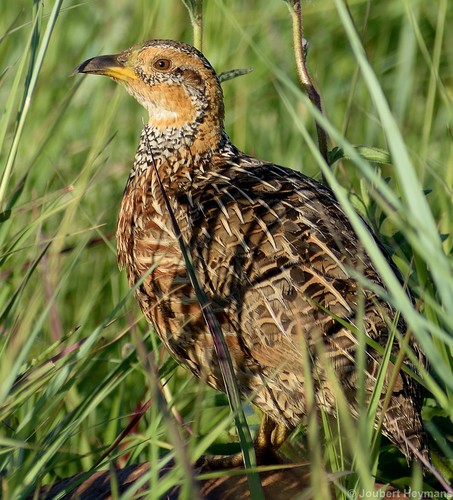
Red-winged Francolin
Scleroptila levaillantii
With its striking white throat and flash of rufous wings, the Red-winged Francolin is a jewel of the African highlands. Often heard before it's seen, this ground-dwelling bird adds a soulful soundtrack to the mountain mist.
Quick Identification
Size
32–35 cm (12.5–13.8 in) in length; weight ranges from 360–550g (0.8–1.2 lbs)
Colors
Upperparts are intricately patterned with brown, buff, and grey; white throat with a distinct black-and-white speckled border; prominent rufous-red flight feathers visible in flight.
Key Features
- Bright rufous-red wing patches visible during flight
- Clean white throat patch framed by a speckled black collar
- Intricately barred chestnut and white underparts
- Stocky, ground-dwelling silhouette with a short, strong beak
When You’ll See Them
Geographic range
Where Does the Red-winged Francolin Live?
The Red-winged Francolin is a quintessential African highland bird, predominantly found across the eastern and southern regions of the continent. Its native range stretches from the mist-belt grasslands of South Africa and Lesotho through the montane plateaus of Zimbabwe, Malawi, and Zambia, reaching as far north as the high-altitude regions of Kenya and Uganda. It is a specialist of well-watered, high-elevation habitats where the grass remains lush for much of the year.
Basemap © OpenStreetMap contributors
Behavior
Red-winged Francolins are predominantly ground-dwelling birds that prefer to run rather than fly when disturbed. They are most famous for their loud, ringing calls often heard at dawn and dusk, which serve as territorial markers for coveys—small family groups of 4 to 8 birds. While they are generally shy, they can become habituated to humans in areas where they aren't hunted, often foraging near rural homesteads or quiet garden edges.
During the day, they spend their time scratching through the soil for food or taking dust baths to maintain their plumage. They are highly territorial, and males will often find a high point, like a termite mound or a rock, to announce their presence. Their social structure is tight-knit, and the group relies on collective vigilance to spot predators like hawks or jackals.
EverydayEarth exclusive
Camera Tips
To capture the Red-winged Francolin, place your camera low to the ground—no higher than 6 to 10 inches. These birds spend almost their entire lives on foot, and a knee-high mounting point ensures you get a clear, eye-level profile rather than a view of the top of their heads. Target the edges of tall grass or areas where the grass meets a dirt track, as they love to use these 'highways' for easy movement and dust bathing.
Since they are active foragers, look for areas with disturbed soil or evidence of digging. While they don't respond strongly to traditional bird feeders, you can entice them with a scattering of mixed wild bird seed or cracked corn in a flat, open patch of ground near cover. They are creatures of habit, so if you spot them once, they are likely to return to that exact spot around the same time the following day.
Set your camera to a multi-shot burst mode or short video clips. Because they move with a characteristic 'stop-start' pecking motion, a single photo often misses the best angle of their intricate plumage. Dawn and the 'golden hour' before sunset are the best times for lighting, but also when they are most active and vocal. If your camera has a sensitive microphone, the video will often capture their beautiful, rhythmic whistling calls.
Similar Species
Species that look similar or are commonly confused with Red-winged Francolin.
Frequently Asked Questions
Record Red-winged Francolin at your habitat
Connect a camera to start building your own species record — AI identifies every visitor automatically.